Is it just me, or is there too $&@^ much stuff to read these days?
It used to be simple - keep up with IDC and Gartner, read a few of the better trades (SD Times, Infoweek), a few magazines (Fortune, Economist), two or three newspapers (New York Times, Financial Times, Wall Street Journal and a representative international paper if it was handy) and voila, I felt informed.
But now I have no idea where the next useful bit of information is coming from. Half of the time my so-called "alerts" fire on crap, and I end up deleting more than I read. My RSS feeds help compress the time it takes to scan the headlines, but I lose the second-tier of information where all the subtlety lives.
When I'm feeling particularly stressed, I rely on the Marumushi newsmap as a substitute for my generic "news" feed. It gives me a good top-level view of the Google News feed across all key geographies, in all key categories, cleverly organized using the dual key of "urgency" (as measured by number of mentions) and "currency" (as measured by when the story hit: less than 10 minutes, more than 10 minutes, more than an hour). It even keeps an archive of stories, by time-of-day, so I can go back and see what was going on during any given period.
That leaves me more time to engage in "urgency skimming" the infosphere through - you guessed it - phone calls and blogs. I have a circuit of well-informed friends I try to speak to on a more-or-less constant basis; they return the favor, of course. I augment this "primary" source through the often-suspect, but nevertheless useful drip of blogs.
Here is the challenge for me, and one I wonder how you handle: If the only information sources you access are the ones you always look to, you'll never see your world through new eyes. How do you enforce randomness in your information gathering? It is as simple as looking for new sources?
Tuesday, February 28, 2006


Monday, February 27, 2006
anti-bozo: embrace archetypes
 I'm guilty (as are many of you, no doubt) of reading GuyK's blog regularly. I readily admit that his blog-fu is more powerful than mine - for example, I can't produce beautifully articulated bullet-lists of wisdom like he can. But in the grand tradition of blogging on the blogs of others (re-blogging?), I had a thought on the topic of how to slow down the insidious spread of Bozos in your organization.
Obviously, you hire for talent, experience and energy. But I'd argue that you also need to hire with an eye toward fleshing out your archetype portfolio.
At the risk of angering all of the Jungians out there, I'm not talking about archetypes as psychoid elemental forces emerging from the collective unconscious. Well, maybe a little.
What I'm really referring to is the importance of bringing together individuals who manifest the peculiar characteristics of the ancient patterns that exist in human consciousness. Or, put more simply, you need to hire more than one "type" of person. And at the same time, you should be aware of both the constructive and destructive qualities of each.
The excellent Metareligion site has an extensive page dedicated to a gallery of such archetypes. Even a cursory review of the site will give you a feel for the many classic "archetypes" found in all of humanity's myths. By comparison, you can explort Wikipedia's entry on archetypes, which takes a decidedly Jungian point of view.
The one I'll focus on is the Trickster, represented in Celtic mythology as the Puca. Metareligion has an excellent discussion of this archetype:
...the Trickster seems at first to have only negative connotations, but it can be a great ally in presenting you with alternatives to the straight and narrow path, to people and institutions who seek to hem you in through peer pressure and conformism. The best modern illustration of this dual role show up in the film work of Jack Nicholson and Groucho Marx. Although the characters they portray are often unsavory or duplicitous on some level, their antics can also be liberating by transcending convention, stuffiness, and predictable behavior.
Who in your company fills the Trickster role? Who challenges conventions, disregards the traditional and resists pressures to confirm? Who transforms through conflict? Or has this archetype been purged from your midst?
Or the Crone? Who is the keeper of conventional wisdom and corporate history? Who knows where you've been? Or have all of these people left the company?
I argue that if you keep company with people who all embody the same archetypes, you lose the ability to pattern your company on the same social structures that have made humanity "work". If you purge archtetypes or restrict your hiring to a limited number of them, you create dysfunctional organizations from the start.
There's always room for some Bozos - because they play an imporant role. Going out of proportion in any direction is what we should avoid, not just the Bozo direction.
Saturday, February 25, 2006
adventure: training the troops overseas
I'm off tomorrow for a week of "training" the sales (inside and outside), field engineering and marketing teams at our Cheshire, UK office. Adding to the excitement is the fact that I've never been to this office, and that I'll be meeting some of the folks there for the first time.
But tonight as I sat at dinner at the neighbor lady's house and feasted on lambs and sloths and carp and anchovies and orang-utangs and breakfast cereals and fruit bats, I wondered. . .
For any of you who once did or still work in a remote office, how disconnected did/do you feel from "corporate"? In my experience there seems to be some sort of chasm of information and culture between you (who are expected to sell) and the home office (where they build the stuff you are expected to sell) that requires a conscious effort to overcome on both parts - but mostly on the part of the folks from corporate.
The best way to overcome it is to. . .wait for it. . .get folks from corporate to visit. Egads!
I swear, sometimes I think more than half of this job is just showing up with something to share and a mission to listen closely. I specifically scheduled nothing other than just "being there" for the week, knowing that there would more opportunities than I even know about now to train, listen, and sit in on some calls with customers.
I know I'll have so-called "down time" during which I can do the hundreds of other things I have pending. And I'll have the benefit of access to really good beer, great TV, and Barley Water.
I bring this up to emphasize - again - that getting out of the office is critical to your well-being, the well-being of your colleagues, and more broadly speaking, the well-being of your firm. This is not to suggest that you sign up for two months of boondoggling. But make it a priority to go visit the folks who you expect to sell the stuff you make. If your boss objects. . .well, let me know.
But tonight as I sat at dinner at the neighbor lady's house and feasted on lambs and sloths and carp and anchovies and orang-utangs and breakfast cereals and fruit bats, I wondered. . .
For any of you who once did or still work in a remote office, how disconnected did/do you feel from "corporate"? In my experience there seems to be some sort of chasm of information and culture between you (who are expected to sell) and the home office (where they build the stuff you are expected to sell) that requires a conscious effort to overcome on both parts - but mostly on the part of the folks from corporate.
The best way to overcome it is to. . .wait for it. . .get folks from corporate to visit. Egads!
I swear, sometimes I think more than half of this job is just showing up with something to share and a mission to listen closely. I specifically scheduled nothing other than just "being there" for the week, knowing that there would more opportunities than I even know about now to train, listen, and sit in on some calls with customers.
I know I'll have so-called "down time" during which I can do the hundreds of other things I have pending. And I'll have the benefit of access to really good beer, great TV, and Barley Water.
I bring this up to emphasize - again - that getting out of the office is critical to your well-being, the well-being of your colleagues, and more broadly speaking, the well-being of your firm. This is not to suggest that you sign up for two months of boondoggling. But make it a priority to go visit the folks who you expect to sell the stuff you make. If your boss objects. . .well, let me know.
Friday, February 24, 2006
resource: the pm bookshelf project
General
The Product Manager's Handbook 3rd ed (Nov 2005)
Author: Linda Gorchels
Amazon
BC 2/06: A good resource for new PMs, this is a broad walk through all the essential disciplines. AdamB reports that this is one of the first books he picked up.
Strategy
Product Strategy for High-Technology Companies 2nd ed (Oct 2000)
Author: Michael E. McGrath
Amazon
BC 2/06: One of the better books on strategy for high-tech companies I've read. It has a useful section on how to define your position in the market vis-a-vis all potential competitors.
Value Innovation: The Strategic Logic of High Growth (Jul 2004)
Authors: W. Chan Kim and Renee Mauborgne (article)
Harvard Business Online
BC 2/06: Every PM needs to have this in his or her library. To quote the HBR's summary of the article:
Metrics and Measurement
Keeping Score (May 1996)
Author: Mark Graham Brown
Amazon
BC 2/06: I belong to the school that says you can't manage what you can't measure. This is an excellent "starter course" by a noted Baldridge examiner on how to manage around a few key performance indicators.
Sales and Marketing
Selling the Dream (Aug 1992)
Author: Guy Kawasaki
Amazon
BC 2/06: Of all of Guys books - and he has a number of them - this is the one with the most to say on the important topic of software evangelism. As a bonus this book also includes a copy of the original Macintosh Product Introduction Plan, which has a kind of quaint charm of its own.
Branding
Designing Brand Identity (Jan 2003)
Author: Alina Wheeler
Amazon
BC 2/06: It's big, it's hardcover, it's a "complete guide to creating, building, and maintaining strong brands". What I like about the book, in addition to the content, is how its designed. It is very accessible. Since much of brand management is the exclusive domain of slick fast-talkers, it helps for PM to have some background on what they're talking about so you don't get snowed.
The Product Manager's Handbook 3rd ed (Nov 2005)
Author: Linda Gorchels
Amazon
BC 2/06: A good resource for new PMs, this is a broad walk through all the essential disciplines. AdamB reports that this is one of the first books he picked up.
Strategy
Product Strategy for High-Technology Companies 2nd ed (Oct 2000)
Author: Michael E. McGrath
Amazon
BC 2/06: One of the better books on strategy for high-tech companies I've read. It has a useful section on how to define your position in the market vis-a-vis all potential competitors.
Value Innovation: The Strategic Logic of High Growth (Jul 2004)
Authors: W. Chan Kim and Renee Mauborgne (article)
Harvard Business Online
BC 2/06: Every PM needs to have this in his or her library. To quote the HBR's summary of the article:
[The authors] found that the thinking of less successful organizations is often dominated by the idea of staying ahead of the competition. In stark contrast, high-growth companies pay little attention to matching or beating their rivals. Instead, they seek to make their competitors irrelevant through what the authors call "value innovation."
Metrics and Measurement
Keeping Score (May 1996)
Author: Mark Graham Brown
Amazon
BC 2/06: I belong to the school that says you can't manage what you can't measure. This is an excellent "starter course" by a noted Baldridge examiner on how to manage around a few key performance indicators.
Sales and Marketing
Selling the Dream (Aug 1992)
Author: Guy Kawasaki
Amazon
BC 2/06: Of all of Guys books - and he has a number of them - this is the one with the most to say on the important topic of software evangelism. As a bonus this book also includes a copy of the original Macintosh Product Introduction Plan, which has a kind of quaint charm of its own.
Branding
Designing Brand Identity (Jan 2003)
Author: Alina Wheeler
Amazon
BC 2/06: It's big, it's hardcover, it's a "complete guide to creating, building, and maintaining strong brands". What I like about the book, in addition to the content, is how its designed. It is very accessible. Since much of brand management is the exclusive domain of slick fast-talkers, it helps for PM to have some background on what they're talking about so you don't get snowed.
(NOTE: If you have books you'd like to see on the shelf, or comments about any of the other books, leave a comment and I'll incorporate your thoughts. Thanks)
viral: marketing usa mens curling
 For those of you who avoid all news during the day so you can watch the 2006 Winter Olympics on the tube at night and be surprised at the outcomes, stop reading now.
For the rest of you, uncork the bubbly and get ready to swing from the rafters, because Pete Fenson's USA Men's Curling team won the bronze today.
Why, Bob, are you mentioning this? Especially in light of your recent penchant for poetic noodling?I'll tell you why. I'm convinced that USA Men's Curling will be the single most marketable sports property to come out of this Olympics for us. And by us, I mean the United States.
The rest of the world has plenty of other stuff to focus on - that nice Japanese lady who won the women's figureskating gold is going to ride around on the shoulders of steamy sumo wrestlers on a golden palanquin for the rest of her life, the Italians are dancing in the streets over their short track speed skating gold, etc etc.
But other than men's curling, what do we have?
- Two petulant speed skaters you want to hose down with boiling oil to make them shut up.
- Another speed skater who has a mob name. (No offense)
- A snowboarder in his pygamas with red hair who reminds Italians of their fondness for throwing tomatos at each other.
- Another snowboarder in her pygamas who blew a method air on her last jump to give the gold away.
- A pair of ice dancers who look like they should be filming adult films on a backlot in Burbank.

USA Men's Curling has "geek-chic" written all over it. I can even see the slogan: Curling - We've Got Big Stones. I bet their on-line store is getting hammered right now.
commentary: does expertise make you an expert?
In a (supposedly private) note to me, Chris T commented:
I remember reading [the expert/expertise post] and thinking "note to self: don't claim to be an expert on resume." You didn't really come to a conclusion, but the arguments you made against claiming to be an expert seemed stronger than those for.
I've always been intrigued by "being an expert." If you think about it, everyone's an expert, however temorarily, in some subject, however small.
For example, presently I'm probably the world's foremost expert on Value Level Metadata in the FDAs Case Report Tabulation format, if only because that's the page of the spec that is presently open on my desk. Ten minutes from now, I'll have relinquished the title, but then I'll have moved on to being "the world's foremost expert in how much coffee is left in the 3rd floor kitchen of B-----'s Montville 200 building." I have an ecclectic field of expertise.
It's all about the scope of your subject.
Thursday, February 23, 2006
reality: alone, but not alone

The reality is that you are alone. You have few if any dedicated resources, you have little in the way of what might be graciously called "cover".
You are constantly under the microscope. You are measured and judged. Your decisions are questioned, your directions are second-guessed.
You have all the responsibility, yet no authority.
At least not in the traditional sense.
The authority you have is what you seize. The resources you obtain are those you bargain for. The cover you obtain is the sum total of your good deeds, your selflessness, your savvy, your ability to be everywhere at once.
Everyone is watching you because you are capable of true greatness.
At the still point of the turning world. Neither flesh nor fleshless;
Neither from nor towards; at the still point, there the dance is.
-- T.S.Eliot, Burnt Norton II, Four Quartets
lesson: what makes a great CEO, me hearties

What makes a great CEO?
2%: Industry Expertise
3%: Creativity
5%: Management
8%: Accountability
10%: Strategy
19%: Ethics
53%: Leadership
(Source: TheLadders.com survey, eWeek 5/23/05)
(n=1300)
Arrrrr!
Wednesday, February 22, 2006
counterpoint: marketing's role in sales support
In her article Don't Confuse Sales Support with Marketing, Adele Revella writes, correctly IMO:
No arguments there. But then she goes on to write:
To which I say, hold on a moment.
For GreatBigCorp, where the role of product marketing is both institutionalized and accepted, this is fine. But even at GreatBigCorp, there is the strong potential for those who would deign to "influence entire markets" to want to retreat into their offices and write sweeping (and too often generic) "buyer personas".
There's nothing wrong with user personas. But they too often become unquestionable law among people who really should be reinventing their world-view of the "customer" on a more or less constant basis.
In my opinion you need to write personas because you need to have a clear idea of who your software is good for today - since there are many customers with lots of money who will atttempt to turn you into a custom programming shop if only you will do that great big deal with them.
More small companies than I can count (and a few larger ones too) have gone into the toilet by turning their product in the direction of one or two major customers - which has the impact of turning them away from their original (and often more worthy) direction.
But let's return to my thesis. There is no debating that sales is demanding - they are merely responding to their customers, and they want to get paid. They are, after all, coin operated. You, on the other hand, are not - you need to pick your battles, support sales when and where it makes sense for you.
And that's the magic. Supporting sales wins you allies, and insights into the customer. It gives you an opportunity to test your thinking in the crucible of real deals. Having gone through a sales support exercise, it's up to you to abstract what you've learned to help the rest of sales.
The real sin is supporting sales and not reaping the benefits of it. Tactical, one-off work doesn't serve the larger mission of marketing. But well-chosen, well-executed and successful sales support absolutely serves the larger mission of marketing. Which is to be in tune with the market.
Sales support buys you co-ownership of the customer, and you want a piece of that action. Just be smart about it, and when you have to say "no", be nice about it.
For another take on this touchy subject, read Constantine von Hoffman's article Culture Crash on the alignment (or lack thereof) between sales and marketing (CMO Magazine, June 2005).
. . .marketing superiority delivers a sustainable, defensible competitive advantage to those who master it.
No arguments there. But then she goes on to write:
It should be easy to see that the time you devote to a single prospect opportunity (clearly a sales role) steals time that could have been used to influence an entire market about the value of your solutions (a reasonable description of the Marketing job).
To which I say, hold on a moment.
For GreatBigCorp, where the role of product marketing is both institutionalized and accepted, this is fine. But even at GreatBigCorp, there is the strong potential for those who would deign to "influence entire markets" to want to retreat into their offices and write sweeping (and too often generic) "buyer personas".
There's nothing wrong with user personas. But they too often become unquestionable law among people who really should be reinventing their world-view of the "customer" on a more or less constant basis.
In my opinion you need to write personas because you need to have a clear idea of who your software is good for today - since there are many customers with lots of money who will atttempt to turn you into a custom programming shop if only you will do that great big deal with them.
More small companies than I can count (and a few larger ones too) have gone into the toilet by turning their product in the direction of one or two major customers - which has the impact of turning them away from their original (and often more worthy) direction.
But let's return to my thesis. There is no debating that sales is demanding - they are merely responding to their customers, and they want to get paid. They are, after all, coin operated. You, on the other hand, are not - you need to pick your battles, support sales when and where it makes sense for you.
And that's the magic. Supporting sales wins you allies, and insights into the customer. It gives you an opportunity to test your thinking in the crucible of real deals. Having gone through a sales support exercise, it's up to you to abstract what you've learned to help the rest of sales.
The real sin is supporting sales and not reaping the benefits of it. Tactical, one-off work doesn't serve the larger mission of marketing. But well-chosen, well-executed and successful sales support absolutely serves the larger mission of marketing. Which is to be in tune with the market.
Sales support buys you co-ownership of the customer, and you want a piece of that action. Just be smart about it, and when you have to say "no", be nice about it.
For another take on this touchy subject, read Constantine von Hoffman's article Culture Crash on the alignment (or lack thereof) between sales and marketing (CMO Magazine, June 2005).
mitzvahs: howyadoin messages from old friends
Some days you forget that the road you're on stretches out both behind you and in front of you at the same time. So when you get messages out of the blue from old friends, like I did today, it's with mixed feelings. I'm glad to hear from them, but I'm sad I lost touch.
I know there are folks out there who are better at staying in touch than others. People like lobbyists, LinkedIn junkies, or Notre Dame Alumni Association members. Others occupy ego-spaces that are relatively cramped and don't admit a lot of company. I'm probably somewhere in between.
I'm reminded of SDS polyacrylamide gel electrophoresis, somehow. It takes current to make stuff move through the gel, similar to how it takes effort to move people through your life.
On second thought, that's an awful analogy.
I know there are folks out there who are better at staying in touch than others. People like lobbyists, LinkedIn junkies, or Notre Dame Alumni Association members. Others occupy ego-spaces that are relatively cramped and don't admit a lot of company. I'm probably somewhere in between.
I'm reminded of SDS polyacrylamide gel electrophoresis, somehow. It takes current to make stuff move through the gel, similar to how it takes effort to move people through your life.
On second thought, that's an awful analogy.
Tuesday, February 21, 2006
lesson: nothing good comes of email
I argued in an earlier post on ack/nak why the phone was better than email.
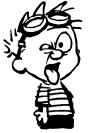
I return to you now with the news that email is good for nothing but pain, suffering and embarassment, and should be avoided at all costs.
Principal contributor to this decision is the Treo650, which provides a near-continuous stream of email from our corporate Exchange server to me 24x7. Not to terribly long ago, I thumbed my way into a world of hurt one morning whilst still sipping my first cup of coffee in my bathrobe. Huge mistake. Other mistakes followed. In an uncharacteristic moment of clarity, I decided I could make the pain stop by simply. . .not. . .responding. . .via. . .email.
So you should avoid writing email all costs. Reading is still required. If you absolutely, positively have to write an email, for gawd's sake, make it one or two lines, don't use a salutation or a closing, and in no circumstances whatsoever should you actually "sign" it with your name.
The best advice I've had all year is to reply to questions about projects with the following:
"I own it, I'm working on it, I'll have it done by (x date)."See how elegant that is? It's the ultimate email-chain-killer. It lets the air out of flame-baiters faster than (insert favorite scatalogical analogy here).
Sure, you can read all the b-school tips you want on how to manage email overload if that'll make you happier. But the cleverer reader will take my advice and just beat that delete button like it owes you money.
Here's the proof-point you're looking for. When was the last time you got a lenghty email from any of the "important" types in your company that was more than one or two lines? Admit it, most of those folks show a near-mythic disregard for the use of capital letters and spelling, and if you're dealing with a real macha, they even dispense with punctuation. These are the missives of the great and good, and they look like they were typed with their elbows while on a two-day bender.
That's the style you should shoot for. It's working for me. Pick up the damn phone and talk to people. Once your colleagues realize that they can't bait you into a seven paragraph thesis on meaningless topics, they'll figure out that they really should talk to you instead of watching their inbox like a Nascar fan waiting for the next big pile-up at Daytona.
wondering: does expertise make you an expert?
There's something to be said for paying attention to what others regard as your areas of expertise. For example: in a superfecta of happenstance, no fewer than four individuals today asked me to help them with tasks that were essentially very similar from my perspective.
When you can point to a confluence of evidence relating to how others see your skills, you start to describe your area(s) of expertise in a practical way. You are not what others say you are - but when you start to read some consistency into what others seek you out to do, it's worth paying attention.
I'm thinking this because I was reading through resumes today and I came upon someone who described himself as an "expert" in yadda yadda, I forget exactly what. Wow, I thought, that takes some cajones to put that in writing. But who's to say he's not an expert? Does it mean he knows everything, or that he has an attitude problem, or maybe he's Just That Good?
I wondered for a little while what I'd want to be expert in. Not just conversant, or capable, or even well-acquainted. Expert. Then I'd put it on my resume, in bold. Maybe even get t-shirts and mugs printed up for good measure with my name and chosen area of expertise on them (for publicity and Christmas gifts).
And if I was a real expert, an uberexpert, I'd be able to convince folks to refer to me as "Bob the [Blank] Expert", a designated savant, a man of obvious competency who is recognized as such by weight of general acclaim.
(John Hodgman's take on this concept is well worth exploring. Especially his litany of Hobo names. All good stories can benefit from a well-named hobo.)
Then I realized that we don't like experts. Experts are self-important, arrogant clods. They have tunnel-vision. They have personal grooming problems. They have a core of meanness that won't quit. And gawd-forbid you challenge them in their area of expertise, for they will go out of their way to humiliate you in front of your mom to prove that they are The Expert and you. . . you would do well to hire a squad of gypsies to render you into lard, toot-sweet.
So much for being an expert. But if you play down your expertise, are you arguing for your limitations? How do you balance expertise with humility? Should you?
Time for some ladies figure skating.
When you can point to a confluence of evidence relating to how others see your skills, you start to describe your area(s) of expertise in a practical way. You are not what others say you are - but when you start to read some consistency into what others seek you out to do, it's worth paying attention.
I'm thinking this because I was reading through resumes today and I came upon someone who described himself as an "expert" in yadda yadda, I forget exactly what. Wow, I thought, that takes some cajones to put that in writing. But who's to say he's not an expert? Does it mean he knows everything, or that he has an attitude problem, or maybe he's Just That Good?
I wondered for a little while what I'd want to be expert in. Not just conversant, or capable, or even well-acquainted. Expert. Then I'd put it on my resume, in bold. Maybe even get t-shirts and mugs printed up for good measure with my name and chosen area of expertise on them (for publicity and Christmas gifts).
And if I was a real expert, an uberexpert, I'd be able to convince folks to refer to me as "Bob the [Blank] Expert", a designated savant, a man of obvious competency who is recognized as such by weight of general acclaim.
(John Hodgman's take on this concept is well worth exploring. Especially his litany of Hobo names. All good stories can benefit from a well-named hobo.)
Then I realized that we don't like experts. Experts are self-important, arrogant clods. They have tunnel-vision. They have personal grooming problems. They have a core of meanness that won't quit. And gawd-forbid you challenge them in their area of expertise, for they will go out of their way to humiliate you in front of your mom to prove that they are The Expert and you. . . you would do well to hire a squad of gypsies to render you into lard, toot-sweet.
So much for being an expert. But if you play down your expertise, are you arguing for your limitations? How do you balance expertise with humility? Should you?
Time for some ladies figure skating.
considered: robert kipniss

"For Stella"
Robert Kipniss (1931-)
(source: Weinstein Gallery)
I first encountered Robert's work at the Patten Gallery in Chatham, MA back in the early 90s. Both he and Nick Patten have sinced moved on (the gallery is now some dreadful tourist trap), but my love of his work continues.
I must be stressed if I'm blogging about art.
saying: kokoro wo oni ni suru
origin: japan
translation: steel your heart with resolve
applicability: immediate
translation: steel your heart with resolve
applicability: immediate
Sunday, February 19, 2006
confused: ice dancing, and other icy sports
At the risk of attracting the attention of roaming death-squads of militant ice dancing fans, I have to admit I don't get it.
But having read the New York Times' coverage of today's events, I finally understand it.
Ice dancing is not an olympic sport - and that's OK. All it needs is Mr. Peterman and it would be complete. It's Olympic Reality TV.
Even Congress got in on the game, passing a law (for all of you who don't remember Schoolhouse Rock and/or slept through your high school civics class, this is what a bill becomes when it gets signed by El Presidente) to grant citizenship to a particularly gifted (ahem) young lady ice-dancer just under the end-of-calendar-year 2005. Oi vey.
With full props to the athletes - ice dancing, snowboard half-pipe, snowboard cross, skeleton - these are TV sports designed to boost ratings and interest in the games. Let's embrace them for what they give us, namely, something to watch on TV in February. But let's not stop with these sports. Let's add more.
So for 2010, let's lobby for the inclusion of the following new winter sports:
But having read the New York Times' coverage of today's events, I finally understand it.
Ice dancing is not an olympic sport - and that's OK. All it needs is Mr. Peterman and it would be complete. It's Olympic Reality TV.
Even Congress got in on the game, passing a law (for all of you who don't remember Schoolhouse Rock and/or slept through your high school civics class, this is what a bill becomes when it gets signed by El Presidente) to grant citizenship to a particularly gifted (ahem) young lady ice-dancer just under the end-of-calendar-year 2005. Oi vey.
With full props to the athletes - ice dancing, snowboard half-pipe, snowboard cross, skeleton - these are TV sports designed to boost ratings and interest in the games. Let's embrace them for what they give us, namely, something to watch on TV in February. But let's not stop with these sports. Let's add more.
So for 2010, let's lobby for the inclusion of the following new winter sports:
- Snowman Assembly (and Pairs Snowman Assembly)
- Metal Saucer Sledding
- Sliding Down Hills in Dress Shoes
- Driveway Shoveling
- Demolition Derby in Snowy Parking Lots
- Knitting
- Short-track speed skating is a gift to us ADHD types. It's an icy equivalent of roller derby, except with angry (fast) Koreans.
- What the heck is the biathalon? Training for Armageddon when you'll have to ski from hamlet to hamlet and shoot at the marauders?
- And then there's Curlilng. It must be a sport of the Knights Templar for as obscure as it is. But having watched an afternoon of curling on the brother-in-law's big HDTV set, it's strangely compelling in a Better Living through Physics way. Try it yourself, especially in the company of a delightful beverage. Or three.
Saturday, February 18, 2006
amazing: blogging from the passenger seat at 75mph
Pennsylvania is beautiful country, but the most astounding event so far today has been my new-found ability to reach blogger.com from the wee little browser on my Treo 650. This is either a new high for me, or a new low... not sure which quite yet.
In any event, my thumb fu is truly strong, huzzah.
In any event, my thumb fu is truly strong, huzzah.
Friday, February 17, 2006
shipped: installshield 11.5 express
We launched InstallShield 11.5 Express today - the big news for this release is support for creating WinMo5 installs. We usually debut new features in InstallShield Professional & Premier editions first, but due to oddness in the availabiltiy of WinMo5, this feature landed in Express first. It'll be supported in Pro and Premier in InstallShield 12 later this year.
Here's the new feature list.I also advise reading the release notes, which are, as always, fascinating:
Visual Studio 2005 Support
Pocket PC Windows Mobile 5.0 and Windows CE .NET 5.0 Support
.NET Framework 2.0 Support
Visual J# 2.0 Support
Microsoft Build Engine (MSBuild) Support
Trialware Expiration Dates
Referencing Developer Installation Manifest (DIM) Files
Because we're going to a coordinated release model, we're going to skip InstallShield 11.5 Express German and Japanese editions and jump directly to Express 12 with support for all three IDE locales.
Here's the new feature list.I also advise reading the release notes, which are, as always, fascinating:
Visual Studio 2005 Support
Pocket PC Windows Mobile 5.0 and Windows CE .NET 5.0 Support
.NET Framework 2.0 Support
Visual J# 2.0 Support
Microsoft Build Engine (MSBuild) Support
Trialware Expiration Dates
Referencing Developer Installation Manifest (DIM) Files
Because we're going to a coordinated release model, we're going to skip InstallShield 11.5 Express German and Japanese editions and jump directly to Express 12 with support for all three IDE locales.
question: on the topic of perpetual licenses
This morning as I pored through pages of SKUs and pricing schemes that threatened to make my eyes bleed, I happened to shuffle a copy of the InstallShield EULA to the top of my paper stack.
The InstallShield EULA is a click-wrapped, perpetual license. Whatever you might happen to think about click-wrapped EULAs, it's the perpetual element that captured my interest.
If you're writing software for sale, there are financial reasons why you'd want to sell perpetual licenses. Namely, you can recognize all the revenue up-front, as opposed to distributing it over the term of the agreement. Customers like it (ostensibly) because they then "own" the license, and can use the product for as long as they like. Often they buy maintenance agreements in addition to the perpetual license, and that gives them access to "fixes" and "new releases", generally speaking.
But I keep coming back to the word "perpetual", because I see the life expectancy of software as a discrete (not perpetual) thing. Whether it is obsoleted by changes to the underlying operating system, changes in how the task it addresses is completed, the vicissitudes of the marketplace that drive products in and out of fashion, software in an installed and operated state is anything but a perpetual entity. It's curious, actually - that we should associate permanency with something so ephemeral as software.
But we wish to "own" software the same way we "own" a pair of shoes, or our house, or our car. It's "my copy" of BlahSoftPro. I paid good money for it, I use it, it's mine, right? Same way these shoes are mine, right?
Except that software (and all digital content) aren't shoes - they are "soft" goods. Curiously, though, unlike music and video, software has more in common with shoes in that they both wear out. But I digress.
From an "ownership" perspective, soft goods are sticky wickets. The possession of a pair of shoes doesn't immediately enable you to duplicate and redistribute them, so we've not had to concern ourselves with the same issues in the shoe world as we do with software, or any digital content for that matter.
That's not to say that Nike doesn't get really, really angry when someone mass-produces knockoffs. But everyone who buys a pair of shoes isn't immediately able (with some minimal effort) to duplicate the shoes ad infinitum.
(On a side note, when we buy a pair of shoes, are we accepting the manufacturer's EULA when we put the shoes on for the first time? Is this analogous to the explicit EULA acceptance that is given when we break the seal on the envelope containing a stack of CDs for some software?)
If it can be copied, it can't be owned, the argument goes, and therefore we have to wrap the "good" (software, movie, song, text, whatever) in the protective arms of a license. A license which we pretend is forever, and which can be challenging to enforce under some circumstances.
Which brings me back to the question of perpetual licenses for things that we expect to wear out.
I think we sell perpetual licenses because many of us deliver software as discrete, stand-alone assets that don't have an embedded life-cycle. We deliver software that does foo, and will continue to do foo. Perpetually. But if we give that software a life-cycle, and embue it with a capability to be continuously updated, extended, configured and integrated into other applications, is it still a discrete, stand-alone asset?
Once a piece of discrete, stand-alone software gains an embedded life-cycle, does it make sense to license it under a perpetual model anymore? Should we grant the right to use a piece of software forever if that software will change and adapt over time? More importantly, when a customer buys software, are they buying it with the intent that it will only ever do foo, or would they prefer to buy it with the expectation that it will do foo+?
Once a software gains this life-cycle, doesn't it become a service - even if you're installing it? Should we limit the use of perpetual licenses for (hard and soft) perishables, but use other forms of licensing (pay-per-use) for mutables?
The InstallShield EULA is a click-wrapped, perpetual license. Whatever you might happen to think about click-wrapped EULAs, it's the perpetual element that captured my interest.
If you're writing software for sale, there are financial reasons why you'd want to sell perpetual licenses. Namely, you can recognize all the revenue up-front, as opposed to distributing it over the term of the agreement. Customers like it (ostensibly) because they then "own" the license, and can use the product for as long as they like. Often they buy maintenance agreements in addition to the perpetual license, and that gives them access to "fixes" and "new releases", generally speaking.
But I keep coming back to the word "perpetual", because I see the life expectancy of software as a discrete (not perpetual) thing. Whether it is obsoleted by changes to the underlying operating system, changes in how the task it addresses is completed, the vicissitudes of the marketplace that drive products in and out of fashion, software in an installed and operated state is anything but a perpetual entity. It's curious, actually - that we should associate permanency with something so ephemeral as software.
But we wish to "own" software the same way we "own" a pair of shoes, or our house, or our car. It's "my copy" of BlahSoftPro. I paid good money for it, I use it, it's mine, right? Same way these shoes are mine, right?
Except that software (and all digital content) aren't shoes - they are "soft" goods. Curiously, though, unlike music and video, software has more in common with shoes in that they both wear out. But I digress.
From an "ownership" perspective, soft goods are sticky wickets. The possession of a pair of shoes doesn't immediately enable you to duplicate and redistribute them, so we've not had to concern ourselves with the same issues in the shoe world as we do with software, or any digital content for that matter.
That's not to say that Nike doesn't get really, really angry when someone mass-produces knockoffs. But everyone who buys a pair of shoes isn't immediately able (with some minimal effort) to duplicate the shoes ad infinitum.
(On a side note, when we buy a pair of shoes, are we accepting the manufacturer's EULA when we put the shoes on for the first time? Is this analogous to the explicit EULA acceptance that is given when we break the seal on the envelope containing a stack of CDs for some software?)
If it can be copied, it can't be owned, the argument goes, and therefore we have to wrap the "good" (software, movie, song, text, whatever) in the protective arms of a license. A license which we pretend is forever, and which can be challenging to enforce under some circumstances.
Which brings me back to the question of perpetual licenses for things that we expect to wear out.
I think we sell perpetual licenses because many of us deliver software as discrete, stand-alone assets that don't have an embedded life-cycle. We deliver software that does foo, and will continue to do foo. Perpetually. But if we give that software a life-cycle, and embue it with a capability to be continuously updated, extended, configured and integrated into other applications, is it still a discrete, stand-alone asset?
Once a piece of discrete, stand-alone software gains an embedded life-cycle, does it make sense to license it under a perpetual model anymore? Should we grant the right to use a piece of software forever if that software will change and adapt over time? More importantly, when a customer buys software, are they buying it with the intent that it will only ever do foo, or would they prefer to buy it with the expectation that it will do foo+?
Once a software gains this life-cycle, doesn't it become a service - even if you're installing it? Should we limit the use of perpetual licenses for (hard and soft) perishables, but use other forms of licensing (pay-per-use) for mutables?
Thursday, February 16, 2006
explore: octavo digital rare books
When asked what I would do with the money if ever I won the lottery (not some small prize, mind you, but a real whopper), I generally say I'd buy a house in New England, stash enough to create a decent income stream, and blow the rest on books.
Bibliomania is a hideous affliction under normal circumstances, believe you me. But I bet I could turn it into something truly wrong with enough cash. And I'd start with some of the texts you can find at Octavo Digital Rare Books, by gum.
But since I have not won the lottery, and given that even if I did, creating suitable storage for such texts would ruin the fun of owning them, I can still take some pleasure in enjoying them at Octavo.
For those of you unfamiliar with the site, it's the creation of Paul Allen who, in a fit of inspiration, realized that modern high-resolution photography could offer scholars and other fans of nice books the ability to study the rarest and most beautiful of them without having to endure the sorts of cavity searches generally inflicted on those brave souls who attempt to do so in person.
Since most of these books rarely see the light of day, it's a wonderful service. I encourage you to visit the site and browse the editions - while you won't get the whiz-bang benefits of actual ownership of a digital copy, you can view some of the pages, and if you're clever, save the image to your computer and view it on your desktop.
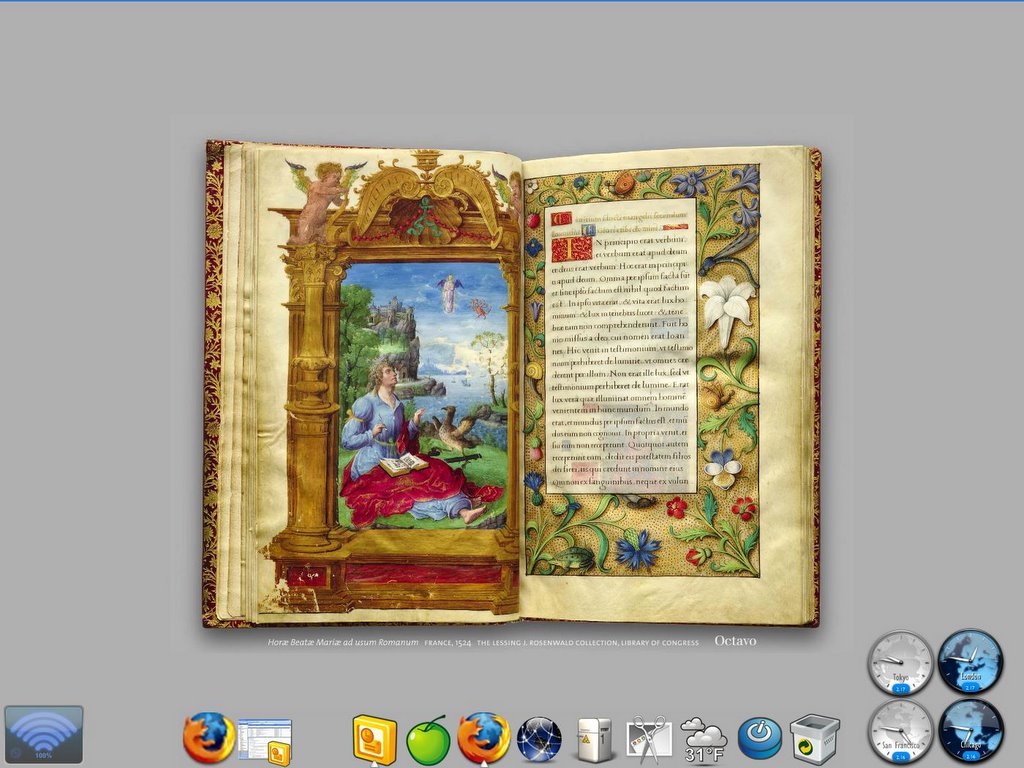
For example, I've got an illuminated page of the Horae Beatae Mariae ad usum Romanum (France, 1524) on my desktop. Normally, this book languishes in the vaults of the Lessing J. Rosenwald Collection in the Library of Congress, protected around the clock by hard-looking librarians with shock rods. But I enjoy it every day, nyah.
For an added thrill, match the background of your screen to the particular shade of grey used as a background to the open book, such as I've done on the picture associated with this post. It's a nice effect.
By the by, that's a screenshot of my Windows XP desktop, using Konfabulator and ObjectDock for widgets.
Wednesday, February 15, 2006
question: why are you going to visit the customer
It is 4:20am central and I'm waiting for my ride to the airport, on my way deep into the heart of Texas to visit customers.
When asked yesterday by a co-worker"why are you going to these meetings" I replied, "to listen".
Funny, he thought I was going "to talk". The struggle to communicate the value of product marketing is never-ending. See you tonight.
When asked yesterday by a co-worker"why are you going to these meetings" I replied, "to listen".
Funny, he thought I was going "to talk". The struggle to communicate the value of product marketing is never-ending. See you tonight.
Tuesday, February 14, 2006
decision: ship, don't ship
Shipping the software causes problems. Not shipping the software causes problems too.
In order for your product to have any impact at all, you have to let it go. But if you want to avoid controversy, keep it in dev or QA just a bit longer, and the impact it will have might be better.
You'll embarass yourself with software that isn't ready. You'll embarass yourself by missing the opportunity to get the product into the hands of users.
The software won't be perfect, and in some cases, it won't work because it's missing key functions you once thought it could never live without. You could take the time to make it perfect, make it work, add those key functions if you wanted to.
It's risky to ship. It's risky not to ship.
This is the heart of the problem. Ship, don't ship. It is analogous to dare, don't dare.
As Virgil and Flaming Carrot say, "Fortune Favors the Bold". So ship. Then ship again.
In order for your product to have any impact at all, you have to let it go. But if you want to avoid controversy, keep it in dev or QA just a bit longer, and the impact it will have might be better.
You'll embarass yourself with software that isn't ready. You'll embarass yourself by missing the opportunity to get the product into the hands of users.
The software won't be perfect, and in some cases, it won't work because it's missing key functions you once thought it could never live without. You could take the time to make it perfect, make it work, add those key functions if you wanted to.
It's risky to ship. It's risky not to ship.
This is the heart of the problem. Ship, don't ship. It is analogous to dare, don't dare.
As Virgil and Flaming Carrot say, "Fortune Favors the Bold". So ship. Then ship again.
question: what do you want to do
Someone asked me this question recently, and I was appalled that I didn't have a compelling, brief and articulate answer. Intent on getting my story right, I turned to Mr. Maslow for help.
We all want to sit at least three rungs up from the bottom of his Hierarchy. No point talking about my physiological, safety and belonging needs.
We all want the esteem of others. But bringing that up makes me sound needy. More than I already know I am, since being a performer carries some requirements for validation along with it by definition.
So it comes down to self-actualization, which is a toughie to talk about. How do you become self-actualized? Is it possible to achieve it through your work? Is it a state of mind, or is it a process? Are you born with it? Can you find it? And once found, can you lose it? If you get your ass kicked on the bottom four rungs, does it go away? Do you get there through struggle? Or is it natural?
I would think that the self-actualized make the best contributions to any endeavor. Kind of like happy cows give the sweetest milk. Ooo, maybe that's a bad analogy.
Ask yourself "what do I want to do" and see how far you get beyond "finish that presentation" or "get more sleep". Tricksy, isn't it.
We all want to sit at least three rungs up from the bottom of his Hierarchy. No point talking about my physiological, safety and belonging needs.
We all want the esteem of others. But bringing that up makes me sound needy. More than I already know I am, since being a performer carries some requirements for validation along with it by definition.
So it comes down to self-actualization, which is a toughie to talk about. How do you become self-actualized? Is it possible to achieve it through your work? Is it a state of mind, or is it a process? Are you born with it? Can you find it? And once found, can you lose it? If you get your ass kicked on the bottom four rungs, does it go away? Do you get there through struggle? Or is it natural?
I would think that the self-actualized make the best contributions to any endeavor. Kind of like happy cows give the sweetest milk. Ooo, maybe that's a bad analogy.
Ask yourself "what do I want to do" and see how far you get beyond "finish that presentation" or "get more sleep". Tricksy, isn't it.
Sunday, February 12, 2006
hazard: three stinky cheeses
You're nearing the end of a lovely French dinner, and as the salad begins to circulate,the smell of the cheese plate grabs you by the nose and smacks you around. You experience an otherworldly fug of mythic proportions. Your eyes water and your throat constricts. You pray for a quick death as the platter floats, seemingly under its own gaseous power, in your direction.
We're not talking an annoying Camembert diaper-pail scent or the heady pong of an elderly Roquefort. We're talking the scent of something in the process of transitioning from a living to a dead state.
You, my friend, should relax - make sure you've got a full glass of red wine and some baguette nearby. As a devotee of stinky cheeses, I'm happy to announce that you're in for a surprise, because your host cares enough about you to offer you something remarkable. Based on the smell, you might be enjoying any (or all) of the following:
Taleggio: An Italian cows-milk cheese best made in Valsassina in the Como region, this little gem looks innocent enough right out of the fridge, but it develops into something substantially smelly as it ripens. It's flavor has been characterized as "tangy" and "assertive", adjectives which can rightfully be called understatements. This is a cheese that will kick your ass and laugh at you. Awesome.
Epoisses: Cows milk. Burgundy region of France. Washed first with saltwater, then with rainwater mixed with Marc de Bourgogne two to three times a week. Favorite of Napoleon. Requires some effort to prevent it from melting down the side of your counter, across the kitchen, out the door where it will hitch a ride and abuse your credit card for days on end. Salty, creamy, pungent, unrepentant. A classic. If someone tries to serve you a Ami du Chambertin, you'll get something a lot like Epoisses.
Aged Cabrales: Cabrales blue cheese is produced only in the village of the same name and three villages of the Penamellera Alta Township located on the northern spur of the Picos de Europa in eastern Asturia. Raw cow, goat and ewe's milk make it into the final mix which is aged (slowly) in some deep, dark caves that are cold, oxygen-rich and humid. The product of all this care is dark, blue-gray and wizened-looking, a moldy heap of organic matter which only vaguely resembles food. Do yourself a favor and attempt to carve off a bit. It may shift to the left and right a few times to avoid your knife. Persevere. Tasting it will let you experience the beauty of the land it came from, the cows, the ewes, the goats. And the cave. Mostly the cave.
If you have a favorite stinky cheese, chime in.
We're not talking an annoying Camembert diaper-pail scent or the heady pong of an elderly Roquefort. We're talking the scent of something in the process of transitioning from a living to a dead state.
You, my friend, should relax - make sure you've got a full glass of red wine and some baguette nearby. As a devotee of stinky cheeses, I'm happy to announce that you're in for a surprise, because your host cares enough about you to offer you something remarkable. Based on the smell, you might be enjoying any (or all) of the following:
Taleggio: An Italian cows-milk cheese best made in Valsassina in the Como region, this little gem looks innocent enough right out of the fridge, but it develops into something substantially smelly as it ripens. It's flavor has been characterized as "tangy" and "assertive", adjectives which can rightfully be called understatements. This is a cheese that will kick your ass and laugh at you. Awesome.
Epoisses: Cows milk. Burgundy region of France. Washed first with saltwater, then with rainwater mixed with Marc de Bourgogne two to three times a week. Favorite of Napoleon. Requires some effort to prevent it from melting down the side of your counter, across the kitchen, out the door where it will hitch a ride and abuse your credit card for days on end. Salty, creamy, pungent, unrepentant. A classic. If someone tries to serve you a Ami du Chambertin, you'll get something a lot like Epoisses.
Aged Cabrales: Cabrales blue cheese is produced only in the village of the same name and three villages of the Penamellera Alta Township located on the northern spur of the Picos de Europa in eastern Asturia. Raw cow, goat and ewe's milk make it into the final mix which is aged (slowly) in some deep, dark caves that are cold, oxygen-rich and humid. The product of all this care is dark, blue-gray and wizened-looking, a moldy heap of organic matter which only vaguely resembles food. Do yourself a favor and attempt to carve off a bit. It may shift to the left and right a few times to avoid your knife. Persevere. Tasting it will let you experience the beauty of the land it came from, the cows, the ewes, the goats. And the cave. Mostly the cave.
If you have a favorite stinky cheese, chime in.
Saturday, February 11, 2006
review: nanny mcphee
Nanny McPhee is a seriously enjoyable fable about loss and renewal wrapped in a 70s-style, Tim Burton-esque package. Don't be put off by the vacuous ads for the movie (the ones with Sting singing "Every little thing she does is magic"), or worse, let them convince you that this is a Mary Poppins remake. While there is "magic", the most enduring isn't performed by the eponymous Nanny McPhee, but rather by and among the members of the family she comes (out of the blue) to care for in their time of need.
If you've got even a few ounces of heart left, you'll shed a few genuine tears on your way to the perfectly crafted ending. You'll have seen it coming for most of the movie, but that doesn't make it's arrival any less satisfying. You can also thank the beautiful set designs, clever casting and deft cinematography for turning what could have been an over-sweet confection of a movie into something honest and engaging. I hope you get a chance to see it.
Quote: "If you need me but do not want me, I must stay. But when you want me but do not need me, I must leave."
If you've got even a few ounces of heart left, you'll shed a few genuine tears on your way to the perfectly crafted ending. You'll have seen it coming for most of the movie, but that doesn't make it's arrival any less satisfying. You can also thank the beautiful set designs, clever casting and deft cinematography for turning what could have been an over-sweet confection of a movie into something honest and engaging. I hope you get a chance to see it.
Quote: "If you need me but do not want me, I must stay. But when you want me but do not need me, I must leave."
thinking: if I could say one thing to a new PM. . .
"So, Bob, I'm thinking about applying for that product manager job. Any advice?"
I looked up from my spreadsheet, blinked a few times. Motioned him to a seat.
"Thanks. Is this a good time?"
"It's always a good time. So you want to be a product manager."
"Yeah," he nodded, all smiling and eager. "You seem to like it. And you get to do all kinds of cool things like set the product direction and talk to the press. I think it would be a great job."
"You get to do a whole lot of cool things, yes."
"So, any advice?"
I had dreaded the arrival of this moment for my entire career. It's one thing when your kids ask you for advice, but here was another professional, a bright, capable guy with his own life and ambitions. Asking me for advice. Without warning.
"Yeah, two things."
I've got one of those black Vornado pedestal fans in my office that I value not so much for its ability to move air but for the steady wash of white noise it creates. Most of the time I'm unaware of it, but for some odd reason I noticed it then, whispering to me of simplicity.
"Actually, only one thing. Who does a PM work for?"
This stumped him. "Well, who do you work for? Wouldn't that be the same person I would work for?"
"Partly. You work for the customer."
"What do you mean?"
"You're a smart guy. . .you've been a programmer, you're getting your MBA, you've got all the skills. But from day one you have to re-orient yourself as an advocate for one person - Joe Baloney who lays down cash for what we're making."
"So you're telling me to be customer-centric."
"Customer-centric is a slogan, a buzz-word. What I'm telling you is to forget about what we call our products, what we think their value is, how we package, price and sell them. The day you become a PM you have to conclude that all those decisions were made by idiots who never left the building."
"But you made a lot of those decisions."
"Exactly."
"So you're telling me that you made bad decisions?"
"What I'm telling you is that I made decisions based on my understanding of the customer. My understanding. You need to build your understanding. You can't trust mine, or anyone else's. It's like a cynical Reagan Doctrine."
"What's the Reagan Doctrine?"
"The Reagan Doctrine. . .never mind that. The bottom line is that you work for the customer, so you need to go out and know the customer. Right away, day one, no exceptions. Because unlike being a programmer who knows how to code, or a sales guy who knows how to sell, what does a marketing guy know?"
"How to talk?"
"We know the customer. Because without that knowledge, all a marketing guy knows how to do is talk, like you said. Talk about what he thinks about the products as they exist today, and what other people know about the customer."
"And what other people think is. . ."
"It's chatter. If all you can do is reiterate someone else's opinions, you're not bringing anything of value, and most of what you'll say, while certainly articulate and interesting, won't matter. Unless you bring the knowledge of what the customer wants with you, you're a worker-bee. Bring that, and you're the most valuable person at the table."
"Don't executives know what the customer wants?"
"They know that unless we build things that people want to buy, bad things happen. Sales knows what their current prospects want. Engineering and support know what the last person who submitted a bug wants. There are a lot of people who think they know what the customer wants. They're all wrong. . .no, actually, they're all probably partially right. It's your job to really truly know. Which is why you work for the customer - all of them, and that includes people who haven't bought yet."
"So you're telling me to know the marketplace."
"No one knows the marketplace. It's like a great big mountain - we can all see it, we can all find our way up and down it, but it's just too big for anyone to truly, comprehensively know it inside and out. The best you can do is to get as much primary and secondary research as possible, talk to as many people as possible, and be aware of what else is happening around you."
"So the best advice you can give me about being a PM is that you need to talk to people."
"Yes. Talk to them, and listen without judgment. Then trust your conclusions and advocate for them relentlessly. Because you don't see any customers sitting around in planning meetings making decisions. They rely on you."
"So you've got nothing to say about how to do the job?"
"I just told you everything. The rest you have to figure out for yourself, because that's what all of us do."
He seemed to chew on this for a moment, then brightened.
"You originally said there were two things, then you only told me one. What was the second one?"
"I was going to say that you should know going in how you plan to get out."
"What?"
"PM is a great job, don't get me wrong. But have you ever noticed why you don't see many 50 year old product managers?"
"Why not?"
"Because the job teaches you something that you absolutely, positively have to know. But once you know it, you want to use it in new ways."
"Like to run a company?"
"Sure, if you want. Or maybe you want to bring a bunch of products together into something bigger. Or maybe you want to take what you know and try to open up a new line of business. There are all kinds of things you can do with what you learn from being a PM without the grind of writing requirements and sweating the details of releases and doing bug reviews and recording webinars."
"I thought you liked doing those things."
"They've got their moments. . .and you have to know how to do them. Think of it like being an apprentice cook. You used to have to start as a commis, an assistant, and you learned by watching different cooks do different things. If you want to read a good book about how to be a great product manager, go read The Apprentice by Jacques Pepin. It's the same thing."
"So you're telling me that I should only be a product manager for a while?"
"You should be a product manager until you know how to do the job."
"How long does that take?"
I smiled wickedly. "That depends on whether your products sell. Which depends on how well you know the customer."
I looked up from my spreadsheet, blinked a few times. Motioned him to a seat.
"Thanks. Is this a good time?"
"It's always a good time. So you want to be a product manager."
"Yeah," he nodded, all smiling and eager. "You seem to like it. And you get to do all kinds of cool things like set the product direction and talk to the press. I think it would be a great job."
"You get to do a whole lot of cool things, yes."
"So, any advice?"
I had dreaded the arrival of this moment for my entire career. It's one thing when your kids ask you for advice, but here was another professional, a bright, capable guy with his own life and ambitions. Asking me for advice. Without warning.
"Yeah, two things."
I've got one of those black Vornado pedestal fans in my office that I value not so much for its ability to move air but for the steady wash of white noise it creates. Most of the time I'm unaware of it, but for some odd reason I noticed it then, whispering to me of simplicity.
"Actually, only one thing. Who does a PM work for?"
This stumped him. "Well, who do you work for? Wouldn't that be the same person I would work for?"
"Partly. You work for the customer."
"What do you mean?"
"You're a smart guy. . .you've been a programmer, you're getting your MBA, you've got all the skills. But from day one you have to re-orient yourself as an advocate for one person - Joe Baloney who lays down cash for what we're making."
"So you're telling me to be customer-centric."
"Customer-centric is a slogan, a buzz-word. What I'm telling you is to forget about what we call our products, what we think their value is, how we package, price and sell them. The day you become a PM you have to conclude that all those decisions were made by idiots who never left the building."
"But you made a lot of those decisions."
"Exactly."
"So you're telling me that you made bad decisions?"
"What I'm telling you is that I made decisions based on my understanding of the customer. My understanding. You need to build your understanding. You can't trust mine, or anyone else's. It's like a cynical Reagan Doctrine."
"What's the Reagan Doctrine?"
"The Reagan Doctrine. . .never mind that. The bottom line is that you work for the customer, so you need to go out and know the customer. Right away, day one, no exceptions. Because unlike being a programmer who knows how to code, or a sales guy who knows how to sell, what does a marketing guy know?"
"How to talk?"
"We know the customer. Because without that knowledge, all a marketing guy knows how to do is talk, like you said. Talk about what he thinks about the products as they exist today, and what other people know about the customer."
"And what other people think is. . ."
"It's chatter. If all you can do is reiterate someone else's opinions, you're not bringing anything of value, and most of what you'll say, while certainly articulate and interesting, won't matter. Unless you bring the knowledge of what the customer wants with you, you're a worker-bee. Bring that, and you're the most valuable person at the table."
"Don't executives know what the customer wants?"
"They know that unless we build things that people want to buy, bad things happen. Sales knows what their current prospects want. Engineering and support know what the last person who submitted a bug wants. There are a lot of people who think they know what the customer wants. They're all wrong. . .no, actually, they're all probably partially right. It's your job to really truly know. Which is why you work for the customer - all of them, and that includes people who haven't bought yet."
"So you're telling me to know the marketplace."
"No one knows the marketplace. It's like a great big mountain - we can all see it, we can all find our way up and down it, but it's just too big for anyone to truly, comprehensively know it inside and out. The best you can do is to get as much primary and secondary research as possible, talk to as many people as possible, and be aware of what else is happening around you."
"So the best advice you can give me about being a PM is that you need to talk to people."
"Yes. Talk to them, and listen without judgment. Then trust your conclusions and advocate for them relentlessly. Because you don't see any customers sitting around in planning meetings making decisions. They rely on you."
"So you've got nothing to say about how to do the job?"
"I just told you everything. The rest you have to figure out for yourself, because that's what all of us do."
He seemed to chew on this for a moment, then brightened.
"You originally said there were two things, then you only told me one. What was the second one?"
"I was going to say that you should know going in how you plan to get out."
"What?"
"PM is a great job, don't get me wrong. But have you ever noticed why you don't see many 50 year old product managers?"
"Why not?"
"Because the job teaches you something that you absolutely, positively have to know. But once you know it, you want to use it in new ways."
"Like to run a company?"
"Sure, if you want. Or maybe you want to bring a bunch of products together into something bigger. Or maybe you want to take what you know and try to open up a new line of business. There are all kinds of things you can do with what you learn from being a PM without the grind of writing requirements and sweating the details of releases and doing bug reviews and recording webinars."
"I thought you liked doing those things."
"They've got their moments. . .and you have to know how to do them. Think of it like being an apprentice cook. You used to have to start as a commis, an assistant, and you learned by watching different cooks do different things. If you want to read a good book about how to be a great product manager, go read The Apprentice by Jacques Pepin. It's the same thing."
"So you're telling me that I should only be a product manager for a while?"
"You should be a product manager until you know how to do the job."
"How long does that take?"
I smiled wickedly. "That depends on whether your products sell. Which depends on how well you know the customer."
Thursday, February 09, 2006
hubris: "pleo is alive"
Ugobe CEO Bob "Von Fronkensteen" Christopher, 21st century golem artiste extraordinare, popped off at Demo '06 in a Cnet video interview yesterday that Pleo, his company's foam-rubber coated, AI-packing, finger-biting diminutive dino, "is alive".
I'm not too happy about this. Toys are toys. What do you tell your kid when he accidentally throws his Pleo out the window of your fast-moving vehicle? "You killed Pleo?" Or when Spike next door straps some explosives on Pleo? "Pleo is a martyr?" Or what about when you fail to keep Pleo charged up? "Pleo is in a coma?"
Sony is still living down the rep they've picked up from purposefully making Aibo and QRIO extinct. And how many Furbee's are blinking in landfills right now, trapped and afraid?
Stop the madness. Leave the creation of life to Korean scientists already. They're good at it.
I'm not too happy about this. Toys are toys. What do you tell your kid when he accidentally throws his Pleo out the window of your fast-moving vehicle? "You killed Pleo?" Or when Spike next door straps some explosives on Pleo? "Pleo is a martyr?" Or what about when you fail to keep Pleo charged up? "Pleo is in a coma?"
Sony is still living down the rep they've picked up from purposefully making Aibo and QRIO extinct. And how many Furbee's are blinking in landfills right now, trapped and afraid?
Stop the madness. Leave the creation of life to Korean scientists already. They're good at it.
idea: tiddlywiki as a creative tool
I've commented before on the merits of lateral thinking - it's an important skill for the non-wonky product marketing guy. I've also commented on the merits of using 3x5 cards for organizational purposes.
But in a brief moment of revelation, it occurred to me that you could use the very nifty TiddlyWiki as a personal tool for enhancing your personal creativity in the same way that some folks use 3x5 cards to help them see problems differently and arrive at novel solutions.
Jeremy Ruston describes his creation as:
(SET HOMER_VOICE=ON; Mmmmm...WikiOnAStick....; SET HOMER_VOICE=OFF)
In English, this means you can take it with you. This portability is a key asset of TiddlyWiki. What Jeremy doesn't note - but which I will - is that a TiddlyWiki is entirely self-contained. It's not a sprawling directory of files and subdirectories. It's tidy.
The other key asset of TiddlyWiki is that it enables a very clever form of content exploration without having to have any sort of pre-established filing taxonomy. Let me explain.
TiddlyWiki employs something called "Tiddlers" for encapsulating micro-content. When you arrive at a TiddlyWiki and click a Tiddler (which looks like a bolded hyperlink), little chunks of content - think of them as tapas compared to the more traditional feast of a normal webpage - pop up on your screen. It's a visual thing, so you need to experience it for yourself. Pop over to the TiddlyWiki tutorial, follow the instructions, then come back. I'll wait for you.
So now you've figured out that Tiddlers are the electronic equivalent of a 3x5 card. Big enough to capture a thought, but too small to encapsulate a whole story.
Here's where it gets interesting. Tiddlers are "tagged" - when you create a Tiddler, you can apply one or more tags to it that describe the content. Tags give you a way to describe paths through your Tiddlers. You can choose tags you've used before, or choose a new one. See, no predetermined filing taxonomy.
If you're like me, any given thought you have on a product, technology, market, whatever it is, can be described with a variety of metadata. By associating this metadata with each Tiddler, you can move quickly through your personal "database". Neat.
In practice, using a TiddlyWiki is dead easy. You don't code anything, you don't modify HTML, you don't mess with style sheets. Neater.
It's also worth noting that Bright People have created plug-ins to TiddlyWiki which you can download and use, including different style sheets to modify the look and feel of your TiddlyWiki. Each one modifies and extends the TiddlyWiki slightly, giving you different controls for storing, manipulating and presenting your data. Be prepared to put your smart hat on when you start playing with them - a good place to start is TiddlyWikiTips.
And if you're feeling really motivated, you can publish your TiddlyWiki to a server for your peers to mock^H^H^H^Henjoy.
It takes a commitment on your part to capture your thinking in a structured way. It takes practice to become adept at using what you've captured in an unstructured way. Because "unstructured use of structured data" is where the magic comes from.
But in a brief moment of revelation, it occurred to me that you could use the very nifty TiddlyWiki as a personal tool for enhancing your personal creativity in the same way that some folks use 3x5 cards to help them see problems differently and arrive at novel solutions.
Jeremy Ruston describes his creation as:
. . .a free MicroContent WikiWikiWeb. . .written in HTML, CSS and JavaScript to run on any modern browser without needing any ServerSide logic. It allows anyone to create personal SelfContained hypertext documents that can be posted to any WebServer, sent by email or kept on a USB thumb drive to make a WikiOnAStick.
(SET HOMER_VOICE=ON; Mmmmm...WikiOnAStick....; SET HOMER_VOICE=OFF)
In English, this means you can take it with you. This portability is a key asset of TiddlyWiki. What Jeremy doesn't note - but which I will - is that a TiddlyWiki is entirely self-contained. It's not a sprawling directory of files and subdirectories. It's tidy.
The other key asset of TiddlyWiki is that it enables a very clever form of content exploration without having to have any sort of pre-established filing taxonomy. Let me explain.
TiddlyWiki employs something called "Tiddlers" for encapsulating micro-content. When you arrive at a TiddlyWiki and click a Tiddler (which looks like a bolded hyperlink), little chunks of content - think of them as tapas compared to the more traditional feast of a normal webpage - pop up on your screen. It's a visual thing, so you need to experience it for yourself. Pop over to the TiddlyWiki tutorial, follow the instructions, then come back. I'll wait for you.
So now you've figured out that Tiddlers are the electronic equivalent of a 3x5 card. Big enough to capture a thought, but too small to encapsulate a whole story.
Here's where it gets interesting. Tiddlers are "tagged" - when you create a Tiddler, you can apply one or more tags to it that describe the content. Tags give you a way to describe paths through your Tiddlers. You can choose tags you've used before, or choose a new one. See, no predetermined filing taxonomy.
If you're like me, any given thought you have on a product, technology, market, whatever it is, can be described with a variety of metadata. By associating this metadata with each Tiddler, you can move quickly through your personal "database". Neat.
In practice, using a TiddlyWiki is dead easy. You don't code anything, you don't modify HTML, you don't mess with style sheets. Neater.
It's also worth noting that Bright People have created plug-ins to TiddlyWiki which you can download and use, including different style sheets to modify the look and feel of your TiddlyWiki. Each one modifies and extends the TiddlyWiki slightly, giving you different controls for storing, manipulating and presenting your data. Be prepared to put your smart hat on when you start playing with them - a good place to start is TiddlyWikiTips.
And if you're feeling really motivated, you can publish your TiddlyWiki to a server for your peers to mock^H^H^H^Henjoy.
It takes a commitment on your part to capture your thinking in a structured way. It takes practice to become adept at using what you've captured in an unstructured way. Because "unstructured use of structured data" is where the magic comes from.
Wednesday, February 08, 2006
grind: the powerpoint deathmarch
Inevitably, all of us get to do this - Someone Very Important is giving a Very Important Presentation which involves Content You and You Alone Know.
You pop off a draft. Then another. Someone gives you some Verbal Edits, then some Written Edits. They might actually incorporate some comments into the deck itself.
Then the deathmarch starts.
It happens when you spin out a few more drafts, then folks start reacting to different versions. You start branching your deck to incorporate feedback, which results in divergent evolutionary lines of your original presentation.
And heaven forbid you use numbers. Oi vey, such a nightmare. Are we talking revenue, or bookings? Are we including services? What about renewals? Direct, direct plus channel? Maintenance?
Then, the final wrinkle - aligning financial targets with the goals of the person giving the pitch.
There are only a few hard and fast ways to get off the road to perdition when it comes to driving these chimeras to a point of minimal consensus sufficiently comprehensive to allow you to breathe easy again.
Then smile. It's fun. Honest.
You pop off a draft. Then another. Someone gives you some Verbal Edits, then some Written Edits. They might actually incorporate some comments into the deck itself.
Then the deathmarch starts.
It happens when you spin out a few more drafts, then folks start reacting to different versions. You start branching your deck to incorporate feedback, which results in divergent evolutionary lines of your original presentation.
And heaven forbid you use numbers. Oi vey, such a nightmare. Are we talking revenue, or bookings? Are we including services? What about renewals? Direct, direct plus channel? Maintenance?
Then, the final wrinkle - aligning financial targets with the goals of the person giving the pitch.
There are only a few hard and fast ways to get off the road to perdition when it comes to driving these chimeras to a point of minimal consensus sufficiently comprehensive to allow you to breathe easy again.
- Involve a limited number of key players and get feedback from all of them throughout the process.
- Be the center of the feedback wheel - interact directly with each of them, and don't allow feedback to travel among them without it going through you first.
- Use lots of crisp bullet points, and very few sentences.
- Be consistent in your formatting.
- Use official financials.
- Follow the Kawasaki rule: 10 slides, 20 minutes, 30 point fonts.
Then smile. It's fun. Honest.
Tuesday, February 07, 2006
welcome: write that down
I wanted to throw a wee little shout out to the author of Write That Down for graciously blogrolling ack/nak.
The problem is, if I call my wife and tell her "hey, good news, I got blogrolled by some guy today", she'll say "so you're gay now, huh."
There ain't no justice, it seems.
The problem is, if I call my wife and tell her "hey, good news, I got blogrolled by some guy today", she'll say "so you're gay now, huh."
There ain't no justice, it seems.
opportunity: working with smart technical people
As I've grown up/older, I've come to acknowledge where my skills and passions lay, and one area of endeavor that just plain doesn't grab me is the deep-dive technical voodoo discussion.
I swear I can't be alone when I say that after a few minutes, all I hear is barking noises. I know they're saying important things that matter, but for the life of me, it comes across as an impenetrable fog of jargon and logic.
Realizing this, and realizing that I wasn't going to bring world-class C++ and Java coding skills to the table, I came to understand I needed to bring something else that would add value to the endeavor of creating software products & solutions.
So what I do is I try to complement the technical smarts of my resident geniuses with an alternative world-view that employs equal parts lateral thinking and heuristics to get them to think about not just the technology, but the impact of the technology on real people (that is to say, customers). I try to be an advocate for the user, for the market, and to bring that perspective in-house. Since customers think differently than developers, this is a worthy skill, and a valuable one.
There's a nice quote associated with this article on ideonomy that describes the benefits of this:
Product marketing (and by that I include product managers who can be deep-voodoo technologists but for business purposes shouldn't always function in that role) needs to bring something to the table for developers that goes beyond another set of hands to specify/code/document. Product marketing needs to be able to relate to development - they have little patience for the utterly clueless, tech-wise - but then PM needs to help them expand their world view.
Here a quick exercise to help you start doing this better. When you have an opportunity to talk to a development manager, start asking "what if" questions to try and veer them off their current path of thinking to explore the very real possiblities that lay to either side of their declared path.
At the end of the day, smart technical people love to build things. It's our job to help them build the right things.
I swear I can't be alone when I say that after a few minutes, all I hear is barking noises. I know they're saying important things that matter, but for the life of me, it comes across as an impenetrable fog of jargon and logic.
Realizing this, and realizing that I wasn't going to bring world-class C++ and Java coding skills to the table, I came to understand I needed to bring something else that would add value to the endeavor of creating software products & solutions.
So what I do is I try to complement the technical smarts of my resident geniuses with an alternative world-view that employs equal parts lateral thinking and heuristics to get them to think about not just the technology, but the impact of the technology on real people (that is to say, customers). I try to be an advocate for the user, for the market, and to bring that perspective in-house. Since customers think differently than developers, this is a worthy skill, and a valuable one.
There's a nice quote associated with this article on ideonomy that describes the benefits of this:
Merely imagining what our ignorance may be can expand the human mind; it can lead to heuristic imagery, new modes of thought, and revealing gedankenexperiments; and it can quicken the appetite for discovery in both young and old. Moreover, it can breed that humility which is so important to the opening up, and the opening out, of reality.
Product marketing (and by that I include product managers who can be deep-voodoo technologists but for business purposes shouldn't always function in that role) needs to bring something to the table for developers that goes beyond another set of hands to specify/code/document. Product marketing needs to be able to relate to development - they have little patience for the utterly clueless, tech-wise - but then PM needs to help them expand their world view.
Here a quick exercise to help you start doing this better. When you have an opportunity to talk to a development manager, start asking "what if" questions to try and veer them off their current path of thinking to explore the very real possiblities that lay to either side of their declared path.
- What if a customer needs to migrate from another product to this one?
- What if what the customer is looking for isn't just product A, but a solution that incorporates products A, B, D and X?
- What if we delay this a quarter or two to work on quality?
At the end of the day, smart technical people love to build things. It's our job to help them build the right things.
Monday, February 06, 2006
rant: on the end of the cyberspace
There's a longish discussion underway at the End of Cyberspace blog on, of all things, the end of cyberspace. William Gibson fans know the word, and it is the opinion of the author that it's ready for retirement. He has solicited input from the great and the good regarding potential replacement names. Being both great and good, I have my own idea or two which I offer for your consideration. I'm feeling a bit cynical, so be warned.
One of the truisms of the 'web', if that antique phrase means anything anymore, is that it has become a vast ever-changing miasma of half-truths, sub-truths, factoids, hearsay, lies, exaggerations, embellishments and general unrepentant opinioneering, all of which suffuse, surround and quite effectively obscure the occasional vein of truth.
In other words, it is a rich vein of randomness and the perfect foil for the contemplative, if that contemplative knows how to sift through the mountains of chaff to find the grains of wheat.
The end of the internet looks like this. In the not-too-distant future, individuals with access to the web of the future will either pay pennies (or nothing) for access to the "wild" internet of unfiltered content and free-range malware, or they will sign exclusive household contracts for ad-subsidized, sterilzed private networks and the hyper-connected single-brand media they serve through proprietary, locked-down hardware. The latter will define themselves as "Sony" families or "Universal" families or "Disney" families. Or whatever.
The former will struggle to sift through the leftovers on their own, but will choose this freely as an alternative to bathing in the glowing sphere of one of the few designated media cartels.
One of the truisms of the 'web', if that antique phrase means anything anymore, is that it has become a vast ever-changing miasma of half-truths, sub-truths, factoids, hearsay, lies, exaggerations, embellishments and general unrepentant opinioneering, all of which suffuse, surround and quite effectively obscure the occasional vein of truth.
In other words, it is a rich vein of randomness and the perfect foil for the contemplative, if that contemplative knows how to sift through the mountains of chaff to find the grains of wheat.
The end of the internet looks like this. In the not-too-distant future, individuals with access to the web of the future will either pay pennies (or nothing) for access to the "wild" internet of unfiltered content and free-range malware, or they will sign exclusive household contracts for ad-subsidized, sterilzed private networks and the hyper-connected single-brand media they serve through proprietary, locked-down hardware. The latter will define themselves as "Sony" families or "Universal" families or "Disney" families. Or whatever.
The former will struggle to sift through the leftovers on their own, but will choose this freely as an alternative to bathing in the glowing sphere of one of the few designated media cartels.
Saturday, February 04, 2006
viral: marketing south park

Perhaps you've noticed I have an off-center sense of humor. If you do as well, you'll enjoy the South Park Studio.
You'll have to put up with a few pop-ups, so be patient. It's a very well-designed Flash-based application for creating your own South Park character.
For example, here's what I managed - modest, yes. But I only had 5 minutes. You have more. Send me what you come up with and I'll post a few of them, if you'd like.
The deeper message here is the power of viral marketing. It's axiomatic that market-eers (is that like Mouseketeers?) drool over the sort of high-touch, low-cost impact a viral marketing campaign can have on a brand. This South Park Studio thingie is a perfect example - I saw it on oishii this morning, checked it out, loved it, blogged it. Virus spread, mission accomplished.
In the market, marketing campaigns can take on viral properties after a period of time, even if the original campaign wasn't specifically "viral". I think this South Park Studio application is an example of this - because it wasn't authored (as far as I can tell) by anyone associated with Comedy Central or the South Park team themselves. The strength of the South Park product (and associated marketing) inspired a customer to spend the time to do this, and viola, a free viral campaign is launched. Think of this as a mutation to the original marketing plan, an unintended consequence.
This is entirely natural; the microbiologist in me knows that after a few generations, viruses often mutate and evolve depepending on the environment they inhabit. For example, a virus grown in the liver will pick up different mutations than one grown elsewhere. These mutations make the virus more "durable" in those tissues; with an increase in specificity and survivability, it becomes more successful - and more challenging to dislodge.
Products with a motivated, passionate base of users will embrace and extend campaigns in unexpected ways. Case in point, Firefox Extensions. Each extension adds value to Firefox in different (and wildly creative) ways; the use of extensions by motivated, passionate users can in turn motivate them to create extensions of their own. Virus spread, mission accomplished.
I think this is a superior form of viral marketing; it's longer-lasting, more valuable, and enjoys the imprimateur of authenticity which is so lacking in most "buzz" campaigns.
Friday, February 03, 2006
request: I want a helper monkey - UPDATED

When things go wrong and will not come right,
Though you do the best you can,
When life looks black as the hour of night -
GET A HELPER MONKEY.
When money's tight and hard to get
And your horse has also ran,
When all you have is a heap of debt -
GET A HELPER MONKEY.
When health is bad and your heart feels strange,
And your face is pale and wan,
When doctors say you need a change,
GET A HELPER MONKEY.
When food is scarce and your larder bare
And no rashers grease your pan,
When hunger grows as your meals are rare -
GET A HELPER MONKEY.
In time of trouble and lousey strife,
You have still got a darlint plan
You still can turn to a brighter life -
GET A HELPER MONKEY.
(original prose courtesy of Flann O'Brian; "Myles holding forth at the bar" by Harry Trumbore courtesy Viking Penguin; oh, and get yer own Helper Monkey)
rule: sales guys <> mushrooms

There is an insidious tendency among some folks in the marketing trade to treat field sales with barely-veiled contempt - "they're coin operated", "they'll use what we give them", "we aim, they fire" are all pithy quips I've heard from well-heeled & dressed, smile-brightened smarties in the past. The worst is "they're just another channel for us".
In short, smoothies like this advocate treating sales like mushrooms - "keep 'em in the dark and feed 'em s&!t".
Since I've "carried a quota" before, I know what it feels like to rely on "marketing". From sales' perspective, marketing sits in nice offices, drinks hot coffee, takes long lunches and publishes the occasional piece of collateral. More often than not, sales can't get a call returned from PM to save their lives, regards the glossies that marketing produces as crap, and prays to dark gods for case studies and metrics that will "actually work".
This is all a sign of bad communication colliding with bad expectations and bad planning.
In my experience, sales and product marketing need to be tied at the hip. Sure, we (product marketing) need to be available for sales calls (phone and on-site), of course, but what we really need is to partner with sales. We need their insight and customer touch - they need our access to engineering, market intelligence, positioning, solution development, research. . .
When marketing and sales collaborate, everyone wins. When it's Spy vs Spy, everyone loses.
Actually, that's wrong: marketing loses first, then sales loses. Then everyone loses.
Thursday, February 02, 2006
warning: gnosticism kills marketing, news at 11

I was thinking about a request I got today to create "a single slide for each of our products describing its go to market strategy".
Reductum ad absurdam exercises can turn marketing into a sterile, lifeless thing. Make sure your presenter knows how to spin stories from a few simple cues and shares your love of the subject matter. And use plenty of pictures.
(ed. the picture above is not a shot of cockroach hair - it is a landscape by one of my favorite artists - Charles Perkalis. He's been shown at the Simon Gallery and numerous other locations. Click on the photo above to link to an online gallery of some of his works.)
Wednesday, February 01, 2006
longing: a short trip to westchester county
I left Chicago yesterday afternoon for a quick trip to Westchester County, NY, and just got back about an hour ago.
Normally, a short day trip somewhere wouldn't be anything to write about. But I was married in Westchester County (Mount Kisco), wooed my wife during visits to her parent's house in Westchester County (Waccabuc), and I grew up in or near the place.
But I digress.
It's a place of unreal, majestic beauty, even in winter. Standing in a corner office up on a small mountain that used to be home to an airport and a golf course until it was turned into a place of pyramids, I looked down over Somers and Goldens Bridge and felt homesick.
It wasn't that I had lived there recently and missed the people, the towns, or even the lifestyle (which can be grueling), but I missed the landscape. I missed the hills, the feeling of being nestled into the hollow of a small ridge, surrounded by granite and the curving swale of the earth.
(note: we don't get many curving swales in Chicago.)
Trip Highlights: I got to order a "coffee regular" at a Dunkin Donuts and they knew what I wanted. I had a piece of pizza the size of a small kite. I had not one, not two, but three people walk through doors in front of me and let the doors close in my face (ahh, good old-fashioned east coast f-you attitude). I got to enjoy the shabby confines of the Rye Town Hilton and a room that Just Would Not Cool Down. And I got to enjoy the bar at the Westchester County Airport for almost three hours after missing an early flight.
Work-wise, it was time very very well spent. It's always fun to go elephant hunting after a steady diet of crushing roaches.
Normally, a short day trip somewhere wouldn't be anything to write about. But I was married in Westchester County (Mount Kisco), wooed my wife during visits to her parent's house in Westchester County (Waccabuc), and I grew up in or near the place.
But I digress.
It's a place of unreal, majestic beauty, even in winter. Standing in a corner office up on a small mountain that used to be home to an airport and a golf course until it was turned into a place of pyramids, I looked down over Somers and Goldens Bridge and felt homesick.
It wasn't that I had lived there recently and missed the people, the towns, or even the lifestyle (which can be grueling), but I missed the landscape. I missed the hills, the feeling of being nestled into the hollow of a small ridge, surrounded by granite and the curving swale of the earth.
(note: we don't get many curving swales in Chicago.)
Trip Highlights: I got to order a "coffee regular" at a Dunkin Donuts and they knew what I wanted. I had a piece of pizza the size of a small kite. I had not one, not two, but three people walk through doors in front of me and let the doors close in my face (ahh, good old-fashioned east coast f-you attitude). I got to enjoy the shabby confines of the Rye Town Hilton and a room that Just Would Not Cool Down. And I got to enjoy the bar at the Westchester County Airport for almost three hours after missing an early flight.
Work-wise, it was time very very well spent. It's always fun to go elephant hunting after a steady diet of crushing roaches.
Subscribe to:
Posts (Atom)