Sunday, April 29, 2007

choshu: constancy


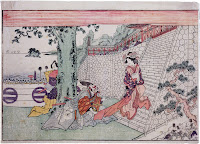
Kudakutemo
kudakutemo ari
mizu-no tsuki

Though it be broken-
broken again - still it's there:
the moon on the water

choshu

from An Introduction to Haiku
translated by Harold G. Henderson
Doubleday Anchor, 1958

literal translation:

Though-breaking | though-breaking exists | water's moon

matt stone: product manager

Fans of South Park know that for years now Trey Parker has not only written but directed each episode. He also does most of the voices for each episode.

So what does his partner and South Park co-creator Matt Stone do?

Matt is the PM. Read about it here.

My favorite quote (from the very end of the article):
Without Parker, South Park would never get written, but without Stone, the episodes would never get made, and the show might have been cancelled years ago. In making a good television show, there are more important things than creativity.

(photo: care of South Park Studios)

leak?: the toast and ham photos


The Ham Song

That's how we did it;
We did it with Ham.
Ham makes everything
Bigger and better.


Your product management lesson: This photo (and another somewhat creepy one of a long-haired, Zelda-inclined gentleman enjoying some toast) is allegedly the work of a program manager in Apple's European consumer electronics business unit. . . with an unreleased iPhone.

Provenance: the picture was posted to Flickr, found through a brute-force text search of EXIF data, reported. . . then later made private and then deleted. But not before copies had been blurted out all over the tubular inter-webs for clowns like me to find.

When it comes to Apple, you never know if it's a plant or a mistake. If it's a planned leak, it's brilliant - and we'll be talking about the Toast and Ham photos for web-years (read=weeks).

If it's unplanned. . . I sense a CLE (a TLA for career-limiting error, where TLA is three-letter acronym).

All the usual suspects are chatting about it today - slow news day, I guess, or just a sign of the semi-rabid interest in this product both pro and con.

I'm more inclined to think it's a hoax.

And now, to mow the lawn and think about Ham and Toast, Toast and Ham.

Mmmmm. . . . . ham.

Friday, April 27, 2007

owned: liberal arts crap

Do a Google search on "Liberal Arts Crap" and the top result is. . .this blog. So it's only correct that I label this post "Liberal Arts Crap" in a spasm of self-reflexiveness that'd make Douglas Hofstadter blink at least twice.


Just for grins, do a Google search on "Exquisite Corpse" and the top result is. . .The Exquisite Corpse, which describes itself thusly:

Caters to the craven complexes of overeducated esthetes while also pleasing the autodidact lumpenproletariat.

The Exquisite Corpse does not show up at all when you search on "liberal arts crap". Hmm. So much for search engines.

(Full Disclosure - I read (and enjoy) The Exquisite Corpse, a site you'll find on my blogroll. It was more fun when it was published on Actual Paper)

quiz: who said this

"The solution is democracy. We have said allow. . .people to participate in a free and fair referendum to express their views. What we are saying only serves the cause of durable peace. We want durable peace in that part of the world. A durable peace will only come about with (sic) once the views of the people are met."

A: American President George W. Bush
B: English Prime Minister Tony Blair
C: Iranian President Ahmadinejad
D: American Speaker of the House of Representatives Nancy Pelosi

phew: long day & looking ahead

Have you ever been in a meeting and come to the simultaneous realizations of "I'm learning something important right now" and "if my blood pressure goes up any more my head will explode"?

That was me. Multiple times today.

I am definitely ready for the weekend - for getting my clock cleaned by my son at Pokemon, for weeding, for making dinner. I'm looking forward to exercising, to playing piano, and to working on my "personal projects".

One question for all of you - do any of you have any specific skills in the printing industry? I have some questions I'd like to ask a professional printer that would only take a few minutes.

Have a great weekend. Play a game, get some sleep. Who knows what sort of oddness I'll come up with here by Monday for your enjoyment.

Thursday, April 26, 2007

story: levelling-up on the train

The 8:13am Metra Union Pacific West express from Elburn stops in my town each morning on its way to the Olgivie Transportation Center.

Being a creature of habit, I ride in the back-half of the third car. It's a "double-decker" train, offering a narrow second level of seats on each side of the train for passengers like me who prefer a little more elbow room.

Starting Monday of this week, instead of reading the newspaper or catching up on email, I've been bent over my Nintendo DS.

"What are you playing?" asked Passenger Tim on Monday. Tim is a sysadmin for the Tribune Company.

I looked up, looked down, then closed the lid.

"Nothing really."

Tim brings his DS from time to time. He had his on Monday.

"Mario Cart?"

I shook my head.

He brightened a bit. "Come on, I'll set up download play and we can race."

"Sorry, I can't. I'm levelling up."

Tim understands what levelling up means.

"What are you playing?"

I sighed. "Pokemon."

He gulped so hard I thought he'd choke.

"Um, Bob, that's a game for kids."

"Exactly. Which is why I have to level up. Otherwise mine will crush me when I get home and he wants to play."

By this time a few of the other riders had tuned in to the discussion. One older gentleman across the aisle shook his head knowingly.

"Buddy, there's no way around it. You can't beat a nine year old at Pokemon. Believe me, I've tried."

Another rider, a gentleman in a suit with the sort of polished look you'd expect of a lawyer, nodded.

"I can't win either. Last night I brought a stone pokemon, he brought a grass. It wasn't pretty."

"Come on, you have to know that," replied the older gentleman. "Save your stone for the flyers."

We all nodded. Because we all knew.

"Better get back to that," offered Tim. "Do you have Exp Share for your backups?"

I flipped open the lid on the DS. "Give me some credit. I might be doomed, but I'm going to go down swinging."

More nods of agreement, then each man went back to his solitary morning pursuits: Tim to his book, the older gentleman to his paper, the polished man to his laptop.

And me to levelling-up.

Wednesday, April 25, 2007

contest: who's the next imus?

Variety.com is reporting that MSNBC is trying out "new personalities" to take the place of Don "Happy-Headed No" Imus. First up for a three-day live trial is Philly's own Michael Smerconish, WPHT drive-time host and "frequent pundit on Fox News".

Without the benefit of the job description (I didn't find the job on Monster or Dice) I can't tell what MSNBC and their Advertising Masters are looking for in The New Imus.

So I'm asking you - who would you put on MSNBC's air to replace The Old Imus?

Tuesday, April 24, 2007

kryptonite: discovered in mine in serbia

No kidding.

From the BBC News article:

Researchers from mining group Rio Tinto discovered the unusual mineral and enlisted the help of (London Natural History Museum minerologist) Dr. Chris Stanley when they could not match it with anything known previously to science.

Once the London expert had unravelled the mineral's chemical make-up, he was shocked to discover this formula was already referenced in literature - albeit fictional literature.

"Towards the end of my research I searched the web using the mineral's chemical formula - sodium lithium boron silicate hydroxide - and was amazed to discover that same scientific name, written on a case of rock containing kryptonite stolen by Lex Luther from a museum in the film Superman Returns.

"The new mineral does not contain fluorine (which it does in the film) and is white rather than green but, in all other respects, the chemistry matches that for the rock containing kryptonite."

Monday, April 23, 2007

unthinkable: vista == me 2

It is too early for anyone to compare Windows Vista with Windows Me ("the home operating system that makes your computer more fun and easier to use").

So let's examine some of the claims made by the vaguely hyperbolic article in The Inquirer around this topic:

Claim 1: Dell is selling PCs with Windows XP installed.

Obsevation1 :I don't think they ever stopped. Just because you can buy a Dell Precision 690 with either Vista or XP preloaded doesn't mean Vista has failed. It just means it takes a while for enterprises to migrate. And while they're thinking about migrating, they still need to provision new PCs with the operating system they're currently using.

Claim 2: Microsoft is selling a $3 bundled license of XP for the Chinese market.

Observation 2: Getting the Chinese to pay anything for software is a major step forward. This sort of pricepoint helps the Chinese to "get legal" at a price awfully close to free. It probably won't help, but it sure can't hurt.

We're a long way away from being able to determine whether Vista is a success or failure. All I can say is that it's no Wii.

boris: dobroi nochi

Boris Yeltsin, 1931-2007

The image of Boris Yeltsin making a speech from the top of a Red Army tank in August 1991 is burned into my memory.

From the NYT article linked below:

In an interview with Reuters in September 1991, Mr. Yeltsin described his feelings at the moment of the coup attempt: “At that time I had only one thought on my mind, and that was to save Russia, to save this country, to save democracy and the whole world, because otherwise it would have led to chaos, to another cold war — or a hot war, for that matter. And that would have been disastrous for the whole world.

“And this is again something that we should always remember: The roots are still there, the roots of the old totalitarian system are still there.

“We need to pull them out, and we should continue along the road of a rule-of-law state, so that the people live better.”

Respect.

photo: Boris Yeltsin at the Virchow Hospital Center in Berlin in February 2006 (Miguel Villagran/European Pressphoto Agency)

story: BBC, NYT

Sunday, April 22, 2007

cartoon: software development


A classic for any industry, but designed for the software world.

documentation: sins of ommission

On a whim last night I tried to whip up Alton Brown's recipe for spinach salad.

Why, you ask. I'll tell you why. And thank you for asking.

It Looked Really Good When He Made It On His Show. Oh, and my wife loves spinach salad. Both Good Reasons.

But when I settled down with the recipe as documented at the link above, a few critical elements were missing.

Normally I'd just chalk this up to "life sucks" or "too darned bad". But how hard can it be to synchronize the recipe that is shown on air with the one that gets put on the website?

Here's one example that goes to the heart of the matter.

On the show, Alton set a large metal bowl on the gas burner and whisked the bacon fat, mustard, sugar, vinegar, salt and pepper together with the gas on. The goal here was not only to combine the dressing, but to get the bowl warm enough to wilt the spinach just slightly when it is added.

Is this reflected in the recipe? Ummm. . . no.

Would it be intuitively obvious to someone who had made thousands of spinach salads that this was the right way to do it? Ummm. . . yes.

But it was not documented.

What assumptions do you make about your users when it comes to your documentation, your UI layout, your use-case workflows? Are you doing the same thing to your users that Alton Brown did to me? Assume a certain level of practical understanding around mechanics on the part of the operator?

In the end, I figured it out. With enough motivation, we always figure it out.

But it left a bit of a bad taste in my mouth, an odd metaphor for making dinner.

Saturday, April 21, 2007

microsoft: sorenson needs a PR lesson

Chris Sorenson, Microsoft's Asia-Pacific head of smartphone strategy, has unfortunately committed one of the most basic PR sins - opening his mouth when he should have kept it closed.

How can I tell? When asked to comment, an official Microsoft Australia spokesperson (read=voice of official PR policy) replied, "I am not interested in commenting".

Uh oh. Let's get to the facts.

In an article published yesterday, David Bruce of ZDNet Australia reported:

Apple's soon-to-be-launched iPhone will be irrelevant to business users because it is a "closed device" and does not support Microsoft Office, a senior executive with the software giant said this week.

"It's a great music phone, and I'm sure it will be fantastic and have an interesting user interface," Microsoft's Asia-Pacific head of smartphone strategy Chris Sorenson told press during a recent visit to Australia.

"However, it's a closed device that you cannot install applications on, and there's no support for Office documents. If you're an enterprise and want to roll out line of business applications, it's just not an option. Even using it as a heavy messaging device will be a challenge," the executive added.

What this non-PR person has said is that "Microsoft believes that anything that doesn't run Microsoft applications is irrelevant to business". What he intended to say wasn't this - but this is what came out.

I'm not here to be an apologist for Apple or Microsoft. Nor am I here to laud the merits of either the iPhone or Microsoft Office.

What I do want to remind all product managers is this - it is the job of the press to write stories on topics that will grab eyeballs, not tell your story the way you want it told.

Reporters will do what it takes to get a story - and it doesn't matter if it is the story you want to tell. This can't be the story that Microsoft wanted to tell. Please tell me it isn't.

We all know the Apple iPhone is a hot story, and by association, Microsoft's thinking on the iPhone is hot. Reporters are circling Microsoft like sharks circling a floating cow with some shaving cuts, looking for someone to say something. . . anything. Microsoft PR knows this.

So kudos to David Bruce. And boo to Microsoft for not planning correctly.

If you have a hot story brewing either inside or around your company and you need to control the "official story", follow these instructions:

1. Make it clear to everyone that all press inquiries should be directed to your PR department or a designated official spokesman. NO ONE SPEAKS TO THE PRESS WITHOUT PRIOR PERMISSION.

2. Instruct all your executives - the Masters of the Universe whose every utterance is law and who loooove to think of themselves as Great Thinkers - to either say nothing or stick to a predetermined set of speaking points.

3. Be prepared for damage control when bright, well-meaning but unfortunately ill-advised employees in highly-placed positions screw up.

It's going to be a long weekend for Microsoft. I have a feeling Microsoft has had a lot of long weekends of late.

Friday, April 20, 2007

indicators: what does your town value?


You can learn a lot about your town by looking at a few simple indicators.


Are panhandlers allowed to congregate in the heart of your town's commercial district, crowding benches and harassing passers by?

Do school referendums fail while park district referendums pass?

Do drivers yield to you in a crosswalk, or do they zoom by you at speed as you stand in the middle of the road?

I've been looking at these indicators - what additional ones would you add for your hometown? If these three were the only ones used to judge my town, it would be 0 for 3.

Thursday, April 19, 2007

swap: gonzales & brown

Question: If Michael D. Brown had been named Attorney General, and Alberto R. Gonzalez had been named head of FEMA, would we be looking at the same result?

Answer: I don't recall.

rewind: agile product marketing?

Given what The Cranky Product Manager had to write about Agile today, I thought I'd bring this one to the front of the queue Just for Kicks and Grins.

/rewind to september 2006/

I feel bad for software product managers. As a former product manager, I'm entitled to express this emotion without fear of reprisal or bemused condescension. They, in turn, are entitled to feel bad for me, but truth be told, they rarely do. But I digress.

I'm watching a number of our product teams as they transition to agile development methodologies, and while I can tell the developers are grooving on it, I'm not quite so sure about the product managers. It could be I just catch them at odd hours.

So in the hopes of coming to understand the challenges my dear colleagues are facing as part of this transition, I went a-searching for some lore on agile software product management marketing.

And whaddya know, I found a whole blog dedicated to it. I shouldn't have been surprised.

For some reason its author chooses to remain anonymous (like the Cranky Product Manager, who has good reason to do so). My guess is the author works on NewsGator, but I could be wrong. It could all be a sophisticated bit of misdirection.

The more I learned about "agile product management" as a discipline, the more the challenge became trying to figure out how product marketing can adapt to the agile development process as manifested in the luminous being of the agile product manager.

Bottom line - what does agile product management mean for product marketing? Off the top of my head. . .
  1. We can help the aPM (agile Product Manager) with iteration sequencing, based on market urgency and availability of ready prospects.
  2. We can - if we're really clever - give the aPM insight into which features are really being used based on market surveys or other magic, so that the aPM can allocate testing resources to where they're most needed. Why test the bejeebus out of stuff that no one uses? It's the classic split between buying and usage features.
  3. We can - and should - guide the aPM's analysis of how much of a feature to bite off the first time around. This is my favorite. aPMs, gawd bless their clever hearts, are often developers deep down, and they have a built-in pride that in some cases prevents them from building a less-than-complete solution - even when they should.

Like their development counterparts, the agile Product Manager thinks in terms of iterations - some of which could be candidates for shipping, if done correctly. Getting successive versions of a solution into the hands of users is the best way to find out if you've gotten it right. Product marketing - if it wants to be agile too - should adapt to think less of monolithic launches and more of "evolving" solutions; done correctly, these solutions should have the capacity to roll into the hands of customers at different rates.

In a way, agile product marketing is postmodern product marketing - it takes an orthogonal view of how software solutions are delivered, used and promoted when compared to the traditional air-lift launch.

Ideally, agile Product Marketing should be able to take a solution stream and condition sales, customers and channels to receive the stream. Doing so won't be easy - just think of all the back-office systems that need to be touched to do this, all the collateral that needs to be updated, salespeople who need to be briefed, channel partners who need to be notified, marcom programs that need to be prepared, analysts and reporters who have to be conditioned to pay attention differently. . .don't forget pricing. . .

The go-to-market complex for start-ups is simple - drop the new build on your FTP site. For the rest of us, it gets complicated. It's one thing for development to deliver products using an agile methodology - but then they have to go to market. "Delivery" from dev doesn't constitute "market availability" - even if you're one of those fancy new-fangled Web 2.0 or SaaS vendors. Compiled Code isn't Ready for Sale. And it's getting the rest of the organization Ready for Sale that poses the greatest challenge for the agile Product Marketer.

More on this later. Who knows, I could just be smoking dope here.

Wednesday, April 18, 2007

competition: quick exercise

Here's something quick and fun you can do with your field sales team. Try it separately with your field engineers, client services reps, or any homogeneous group.

1. Hand out sticky pads until everyone has one. This is an important first step worth getting right. It would be helpful if you had different colored pads, but it is not essential.

2. Ask for a participant who can mark off three minutes.

3. Announce the following: For the next three minutes, you are going to write down - one per sticky note - a competitor you've heard a prospect or customer mention in your territory. Not a competitor you've read about, or think might be a competitor, or would like to be a competitor. And it doesn't have to be a commercial competitor.

4. On each of your sheets, jot your initials on the lower right corner. This is another step worth getting right, for reasons I shall explain. If you have reps with the same initials, ask them to write their first name and last initial. If you get duplication there, ask for full names. If you have duplicate names, use snarky nicknames like "Kevin the Hat".

5. Once you are sure everyone understands what they are expected to do, say go.

6. Leave the room. Use the next three minutes to enjoy a tasty beverage.

7. Reappear magically after three minutes.

8. On a nearby white board, write the numbers 1, 2, 3, 4 and 5 horizontally across the top, with plenty of space between them. Use the whole board. Go ahead, your participants will appreciate the elbow room.

9. Now using the scale of "1 is a competitor that someone mentioned in passing but was never considered as a credible or desirable alternative" through "5 is a competitor who is actively, and perhaps successfully, working to take food from your children, impugn your good name and destroy shareholder value for our fine firm, leading you to feel that we need to deal with them in an urgent way", ask the participants to take their sticky notes and place them under a number from one through five. This exercise is not timed, and it should only take a few minutes.

10. Once they are done, make sure that no one has been clever by placing a note half-way between two numbers. No fractions.

11. Using a handy dry-erase pen, mark a number 1 on each sticky note found under the number 1 on the board. Take them off the board in a nice sticky stack. Repeat for those notes found under numbers 2 through 5.

12. Thank the attendees, and tell them that you will be summarizing what they've reported to you in a follow-up email.

13. Leave, taking the sticky notes with you. Don't comment on what anyone has written, or suggest any conclusions from ad hoc groupings that may have emerged. Smile and wave.

Now this is where the fun starts.

Using your favorite spreadsheet program, record the three data points found on each sticky note:

1. Reported Severity
2. Name of Competitor
3. Name of the Rep

Using your Mad Spreadsheet Skillz, derive the following:

1. The number of competitors reported by rep. You're going to add up the slips that have the same initials on them.

2. The average threat reported by each rep. Exampli gratia: if a rep reported four competitors having a threat level of 1, 2, 2 and 3, add these up (8) then divide by the total number of reported competitors (4) to get the average threat level (2).

3. A ranking of the competition, by rep.

4. A ranking of competitors by number of times reported.

5. A ranking of the average reported threat for each competitor.

I'm not going to come right out and tell you what this information will tell you. I'm curious what you think of the approach. Especially when you compare "the real world" to what your own product management view of the competition.

Tuesday, April 17, 2007

li chi: corollary to previous post


The sweetest food, if left untasted,
Remains unknown, its savor wasted.


A paraphrase of a statement in the Chinese classic Li Chi
from the opening to Act One
Chūshingura: The Treasury of Loyal Retainers (Columbia University Press, 1971)

resources: Story summary, IMBD reference, Wikipedia for Chūshingura, Wikipedia for Forty-seven Ronin

watts: three views of the world

Human beings have had three great views of the world. One is the Western view of the world as a construct or artifact, by analogy with ceramics and carpentry. Then there is the Hindu view of the world as a drama, looked at as a play. Third is the organic Chinese view, looking on the world as an organism, a body.

But the Hindu view sees it as a drama, or simply that there is what there is, and always was, and always will be, which is called the self; in Sanskrit, atman. Atman is also called brahman, from the root bri: to grow, to expand, to swell, related to our word breath. Brahman, the self in the Hindu worldview, plays hide-and-seek with itself forever and ever. How far out, how lost can you get? According to the Hindu idea, each one of us is the godhead, getting lost on purpose for the fun of it. And how terrible it gets at times! But won't it be nice when we wake up? That's the basic idea, and I've found that any child can understand it. It has great simplicity and elegance.

Alan Watts
The Journey from India
from Buddhism: The Religion of No-Religion (Tuttle, 1996)

chicago: mysterious park photo


As I'm not particularly interested in the Sculpture Copyright Police coming after me, let's just leave the provenance of this particular photo to the imagination. That said, I encourage all of you to visit Chicago's Millennium Park this summer, especially once the Face Fountains get fired up. Or is that "watered up".

Monday, April 16, 2007

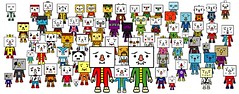
to-fu: iconic toy archetype


photo: TO-FU
Originally uploaded by poorboyneverock

concept: To-Fu by DevilRobots

I won't admit to owning as many of these toys as I actually do. But I will admit to admiring the team at DevilRobots for taking a simple concept and spinning it into a franchise.

photoset: grickily's krazy kids from flickr

rewind: nothing good comes of email

Over a year ago I wrote that nothing good comes of email.

Riding in on Metra this morning I was reading about (insert topic of technical interest here). Following my own advice, I wrote a quick two line email asking my CTO what his thoughts were on the topic.

A few minutes ago he picked up the phone and called me - just me - to talk about it. It was a 30 second conversation that answered my questions and left me with an idea of where I should look next.

Here's your tautology of the day: A symptom of a bad corporate culture is bad communication, and a symptom of a good corporate culture is good communication.

Email is still evil. We can - and should - use it less, and be more efficient in how we use it. But in an environment of mutual trust and respect, email is less evil.

Here's my test - have you had to blind carbon copy (bcc:) someone on an email? If yes, how frequently have you done so?

I'll posit that if you use bcc: often, something's wrong that goes beyond email.

Saturday, April 14, 2007

widget: jyrik's shiny weather icons


Originally developed for Samurize, JyriK's "Weather Icons Shiny" are simply beautiful. Download them for use with Stardock's ObjectDock or any other widget application that employs separate icons for each distinct weather condition.

contrast: working alone/together

In No Admittance, Sippican Cottage wrote:

The office building is the text version of belching smokestack-noon whistle-timecard punching-id badge-break room-factory of my youth. The cubicles and the old CRTs and the in and outboxes are the assembly line of text now. That's the modern version of the old sepia colored photo of a humming factory. You nice folks with the boxy shoes and skinny glasses and the Blackberrys and ACT folders open are the buggy whip people now. You are the people who used to wear coveralls and carry a sandwich in a pail and grind it out until you get a watch and bed with a lid. Not me.

Ron Fisher has also spoken - eloquently and at length - about something he calls "the end of work". He can envision a world in which we all function as autonomous agents who come together on an as-needed basis to exercise our skills.

From what they've written and said, I can infer (with creative license) that for craftsmen such as these the so-called "corporate world" is a fluorescent-lit hell, populated by pallid masses of the fooled.

I would respectfully disagree.

Twenty years ago, the concept of working for a single company for your career wasn't dead, but it was reeling. Today, there are few if any pensions, little security, and no promise of employment if you follow the rules and fly right.

But we still come together to get things done. We rally together, joined by a common vision and sense of urgency.

When we work from home - or work remotely - there's still a sense that we're connected to a place and the people who inhabit that space. Whether this is hard-wired into our reptilian brain or not, there is something very primal about working together, side by side. Even if that "work" is to create something intangible, such as software, or a health care communications platform.

It's not about showing up to punch a card. It's not about "putting in face time". We work together because, in a way, we need to be together, and that sense of togetherness and belonging is in-and-of-itself a major motivator.

If you've ever worked in a "remote office", you know the feeling of being disconnected from "the center of power". A colleague recently moved from Boston to Chicago, and I can tell you that he's already a few orders of magnitude more effective (and better understood and appreciated) now that he's here. With us.

There may come a time when we can all exercise our individual crafts from the comfort of our home offices, when we can roll out of bed and "get busy". For certain of us who are truly craftsmen, this works. For the rest of us who function best when we function as part of a team, there will always be a real benefit to looking each other in the eye.

flashback: a crappy retail experience (with recommended fix)

I'm going to bore you with this story. Please, don't bother reading it.

Let's flash back to a conversation I had at a local GameStop store about an hour ago.

Me: "What can you tell me about Elite Beat Agents for the DS?"

Him: (tears himself away from chatting with his co-worker) "I can tell you that it's really, really dumb. But, it got some good reviews."

Me: "How about Cooking Mama?"

Him: "If you like cooking, I guess it could be fun."

Me: "Thanks."

(shift forward about five minutes - I had the game I came in to buy in my hand and was standing at the checkout counter)

Him: "Will that be all?"

Me: "Yes. You talked me out of the other two games I was about to buy."

Him: (Vacant Expression)

Me (internal voice): "Let me spell it out for you, kid. Not only did you not answer the questions I asked you, but you went out of your way to be rude and condescending to me. You might disagree, but it doesn't matter what you said, it's how I heard it."

Him: "That'll be $21.50."

Me (internal voice) :"I know that you're probably not terribly excited about answering my questions, and I know the games I was asking about weren't 'the new hotness'. But this is retail. Your job is to sell things. My job is to figure out reasons not to buy things. Here, let me show you how this conversation should have gone."

Him: (rings up the one game, tries to get me to pre-order "Pokemon DS Pearl", is oblivious to my internal dialog)

Me (internal voice): "I ask, 'What can you tell me about Elite Beat Agents'. You say, "I haven't played it, but it's gotten some very good reviews, and from what I've read it's a music and rhythm game. Do you like action or puzzle games?' I reply, 'I'm a fan of both'. You say, 'Then you'll probably like it. And if you don't, you can always bring it back for credit.'"

Him: (tells me to point my credit card's magnetic strip down on the credit slider)

Me (internal voice): "Then I'd have asked you, 'What can you tell me about Cooking Mama?' And you'd say, 'Now that's a really ingenious game that only Nintendo could pull off. The game is all about cooking dishes. You use the stylus to chop, sautee, stir, all kinds of things, and you score points based on how well you do it. It's doing really well, there's even a Wii version of it." And I'd have said, 'Well, I can only get one of these two, what would you recommend?' And you'd have said, 'Based on what you've told me, and what I know about Cooking Mama, I think you'd really enjoy that one the most. And again, if you don't like it, bring it back.'"

Him: (mumbles) Haveagoodday.

Me: Sure.

Wednesday, April 11, 2007

hooray: the drinky crow show

Many years ago I snuck into a Manhattan bar just north of Union Square looking for a man with a bag.

I found him drinking a beer and staring up at a hazy TV screen. I sat down next to him.

"Tony?"

He gave me the classic New York "who the f___ are you" look.

"I'm Bob."

The "who the f___ are you" look was replaced by the "where the f___ have you been" look.

"Have you got the money?"

I slid an envelope across the bar to him. He opened it and thumbed through its contents.

Without a word he opened up the bag by his side and pulled out a thin envelope. Inside was an incredibly ornate drawing of a ship at sea, its mast on fire, its prow under attack by a giant squid. Seated at a grand piano on the deck of the boat was Uncle Gabby. Drinky Crow was dueling with the squid while trying to balance a bottle.

"That's a real piano there," he said, stabbing a finger at the drawing. "I modeled it after an antique grand piano. Let me tell you about it. . ."

Our conversation - and my view into the mind of Tony Millionaire - was brief, but very memorable. Since then I've been "a big fan", and I'm delighted to learn that he'll have an animated show on Cartoon Network soon.

Read the press release here.

Enjoy the opening sequence below, or here.


Care of Mr. Millionaire himself, you can enjoy another clip below, or here.

malkin: (imus v. sharpton) v. reality

Michelle Malkin has it figured out.

One dumb radio/television shock jock's insult is a drop in the ocean of barbaric filth and anti-female hatred on the radio.

Imus gets a two-week suspension. What kind of relief do we get from this deadening, coarsening, dehumanizing barrage from young, black rappers and their music industry enablers who have helped turn America into Tourette's Nation?

I'll add my USD$0.02:

When Imus comes back, there should be a new person in his studio - the dump guy. The dump guy sits at a desk with one thing on it - a dump button. Whenever Imus or one of his lackeys or guests says something that could even have the possibility of damaging his corporate masters at MSNBC and CBS, he hits the button.

Why neither MSNBC nor CBS had this level of editorial oversight on Imus' live performances is beyond me. At the end of the day, they are responsible for Imus' words making it to air - not Imus.

You can't blame the monkey for hitting you in the face with poo.

This is not to suggest that Imus is a Poo-Flinging Monkey. But I'm just saying.

EDIT1: Reader Mia's comment to this post includes a link that didn't format quite correctly. I include it here as a public service (and as a bald-faced attempt to suck up to a new reader):

http://joeleonardi.wordpress.com/2007/04/11/don-imus-is-a-jerk-whats-new/

EDIT2: It's all moot. Both MSNBC and CBS have dropped Imus. Money talks, suckers walk.

snow: in april, with eliot chaser

It's not unusual for my neighbors to the north to get snow as late as April.

But it's certainly is unusual to wake up and discover two inches of icy snow blanketing the earth here in the western suburbs of Chicago.

It's an apt metaphor for what's going on here at ack/nak - we took a bit of a break here for the Easter holiday and a visit from the parents, and when time came to sit down and write again, the earth was still. And cold.

APRIL is the cruellest month, breeding
Lilacs out of the dead land, mixing
Memory and desire, stirring
Dull roots with spring rain.
Winter kept us warm, covering
Earth in forgetful snow, feeding
A little life with dried tubers.

The Waste Land
T.S. Eliot (circa 1922)

Friday, April 06, 2007

motivation: transparency and the chorus

Preamble: I get a day off and my eyes still crash open at 5:30am. Go figure.

Jeff Lash, author of the eminently practical How To Be A Good Product Manager, left a link comment for me in the wee hours of this morning. Thank you Jeff.

Jeff writes practical guides on how not to suck at being a PM. I'm a big fan. On behalf of PMs everywhere, I will extend my thanks to Jeff for his tremendous service, as it is so

(SET SHATNER_VOICE=ON)

incredibly. . .easy. . . to suck at being a PM.

(SET SHATNER_VOICE=OFF)

I'll even posit that "How to be Good at X" is not the same thing as "How Not to Suck at X". But I digress.

Let's take a few steps back and consider our role in the organization. We few, we happy few product managers are lobbyists, we're ninja-smart cat-wranglers and duck-herders. We cajole, we encourage, we align, we direct. But we rarely ever "own". We don't speak for ourselves, since we have no true "power".

When we say "no" we're acting as the spokesperson for something bigger than ourselves, for a vision-driven operational plan on whose successful execution the future of the company depends.

I'd like to think our motivations are utterly transparent. So when we say "no" (or "yes" for that matter), we're merely acknowledging that a certain request is not in alignment with this plan.

In the end, all I can do to "not suck" in this area is to work to make sure that everyone understands the plan, everyone owns it, which has the practical effect of making my "no" just one voice in a chorus of "nos".

(Side Note - Today is Good Friday. Not the most fun day in the Catholic calendar.)

Thursday, April 05, 2007

story-redux: i/o hazard chapters 1 and 2

In the transition from old Blogger to new Blogger, something wacky happened to my RSS feed. Rather than serve up the most recent posts, it is serving up posts from eleven months ago.

A friendly ack/nak reader discovered an earlier post titled "story: of cores and hazards and tech-support monks" and asked the question:

Great post - but where from...?

My overweening ego compels me to respond - it's a piece of mine, written during one of my previously frequent jaunts between ORD and SFO.

Two chapters of a larger work I'm doing under the working title i/o hazard have been posted to ack/nak. They are:

of cores and hazards and tech-support monks

in the documentation scriptorum


In the interest of not boring my readers, I opted against posting any other chapters from this work - if you are keen to read them, or if you'd like to participate in what will likely be a fairly rigorous editing process, let me know.

Wednesday, April 04, 2007

sigh: saying no


We're getting ready for our field sales force to come into the office in a few weeks. One of our jobs is to brief them on the whirlwind of activities going on "in headquarters".


"It's really important," said the head of one of our sales teams, "because they don't really see what we do every day. Their impression of us is skewed. They see Bob saying no to deals they want to do. . ."

Pretty much everything after that was "woof woof woof" to me.

Am I really the guy who says no?

"No, we're not going into that segment right now."

"No, we're not a custom programming shop."

"No, that's not enough money to shuffle our devqueue."

I guess I am. Because the "no" responses don't stop there.

"No, I refuse to accept that the way we're doing things today is the way we should always do them."

"No, it's not good enough to be good enough."

"No, we really don't know what our prospects are thinking until we ask them."

There's a song by "They Might Be Giants" called. . .wait for it. . .

No.

No is no
No is always no
If they say no, it means a thousand times no
No plus no equals no
All nos lead to no no no
Finger pointing, eyebrows low
Mouth in the shape of the letter O
Pardon me -- No!
Excuse me -- No!
May I stay?
Can I go?
No, no, no
Do this -- No!
Don't do that -- No!
Sit, stay, roll over
No, no, no
Finger pointing, eyebrows low
Mouth in the shape of the letter O
Red means stop. Do not go.
No, no, no.


My nice-guy center tells me that it's nicer to say yes.

At which point the 400-pound Ukranian female wrestler of my better judgment delivers a suplex to my nice-guy center from the upper turnbuckle.

Then she makes nice, because I say no with love. Tough love. One Would Hope that Saying No is the Logical Precursor to Saying Yes.

Because there is the same compelling need to justify No as to justify Yes.


Except that you get to twirl your Snidley Whiplash moustachios when you say no.

Monday, April 02, 2007

concept: the value of a penny

Well nothing that's real is ever for free and you just have to pay for it sometime. --- Al Stewart

How many times have you been involved in a pricing exercise? Now ask yourself how many times you've been involved in a value exercise? Do you spend as much time calculating the value you deliver as you do determining how much the customer should pay for it?

Soft benefits for hard dollars. . . I've sung that tune. If you've sung it too, or if, G-d forbid, you're singing it now, try this idea on for size (if you're pushing open source software, sorry, you can't play):

Reduce the cost of your product to a penny. Enough that your customer has to go through the exercise of paying for it - a process that on its own will cost more to their company than what you're charging.

Would they still do it?

I'm not suggesting you need to do a full-blown ROI study for everything you sell. But I am telling you that you need to answer the "so what" questions about the value your product or service delivers before you begin to consider price. Unless you really like long sales cycles and deep discounts.

Once you think you've answered all of the "so what" questions, be prepared for the killer "really" retort. Extravagant claims that strain the credulity of your buyer must be justified. Or else.
"The AckMe Mark IV Articulated Frabjulator is the only product of its kind on the market today with a triple-phase actuator arm!"

"So what?"

"The triple-phase actuator arm accelerates widget acquisition and displacement to unheard-of levels!"

"So what?"

"Speeding up your assembly line increases the efficiency of your entire operation!"

"Really."

"Ummm . . . ."

Sunday, April 01, 2007

updates: ack/nak upgraded to new blogger, etc.

After a few starts and stops this weekend, I think I've managed to upgrade all of ack/nak to the "new" Blogger. And with the help of Hoctro I picked up a third column.

Some notes:

1. Not all posts have been "labled" yet. It is going to take me some time to work my way through the Vast Sprawling and Occasionally Steaming Pile of posts and categorize them. If you have any hints on labels other than those you'll see over there --> let me know.

2. Feedburner may be broken. The "old way" of handling feeds involved a template change, and that isn't what I've done here.

3. Sitemeter has been dragging all weekend long. It won't take much for me to start running all of my stats through Feedburner if this keeps up.

4. Groove on the new "Library Thing" widget! I'm one of those compulsive types who loves to create lists. So it was impossible for me to resist the urge to document my library. . . a task which will take a loooong time, but in the meantime, we all get the cool widget down on the lower right to have fun with.

5. Peek-a-boo comments are history. I'm not quite ready to monkey around with the template to make them work. Sorry.

6. The "description" of ack/nak has changed. I think we've moved on. So I've changed it from "postmodern product management" to the more evolved exhortation which now graces the header.

7. New template, new colors. This template is a derivative of the "Rounders" template, once again care of Hoctro.

8. I continue to eschew the temptation to put ads on ack/nak. You deserve better.

9. I got rid of a few other items - the Technorati search box wasn't helping much, and with the addition of labels and the vastly improved archive widget, it wasn't necessary.

10. You may be asking yourself, "Self, what was Bob smoking when he wrote that so-called 'about ack/nak' piece in the center column?" For your information, I wasn't smoking anything. But as a fan of the koan, I liked the way this story harmonized with my new theme. Astute readers will note I've taken some liberties with the story. Astute readers shouldn't care.

(Headline font - Badaboom BB)