Heading back to my pod I ran into a team of tech support monks heading the opposite way, gliding along in their long black hooded robes with the lead guy waving a censer back and forth and all of them mumbling in SQL. I caught the eye of the last one on the line as I pressed up against the wall with my coffee to get out of their way. He looked to be about my age, early twenties or so but much more on-focus than me, cleaner-cut, with eyes that said I may be the ass-end novice but I've got myself more together than a corporate IT pod-puke like you.
Which I took pretty bad, it being only my first week on the job and all.
It wasn't like I was some grunt right out of a nine-week state training class or something. I had a real degree, from a real school. Sure, it was in biology, but who cares what you studied, just so long as you made it out in four and kept your alumni association tithes current. It was the connections that really counted in the long run, the old boy network promised, and I believed them. Three years in pharma later I got smart, kissed a few asses like they told me to and soft-landed in pod 43A2 north, Magnamech HQ, next to another new guy named Karl and a crew of cute uniformed Asian accounting temps who wouldn't give me the time of day.
"Man, they spook me out," Karl said for the thousandth time that week. It hadn’t taken me long to figure out he wasn't a big fan of Cores and support rituals, and the fact that Magnamech had one didn't sit well with him. I nodded a few times and sipped my coffee. My dad told me to shut up and listen, people always say more than they should.
"I mean, look at them, all secret and freaky,” he said, a little louder once the monks had turned the corner toward the elevators. "Give me a good Clone on weekly refresh and an open line out and I'll get some real work done, man."
”Karl, let’s say the Troll found you with a Clone,” I said, settling into my chair. “He'd probably kill and eat you, burn down both the box and your pod, and chalk it all up to standards management.”
“Then he’d get you for not reporting it.”
“You don’t mess with the Troll. You wouldn’t even get it in the building, much less out of the box.”
“Damn shame, too.”
I spun around in my chair, powered up my station and winked a couple of times into the authentication strobe until it recognized me and let me in. Karl was still talking--it took me a few seconds to realize he was still talking to me.
"What the hell are you doing, Mike? You're going nowhere, all lines to the Core are flat down until those Dominican techs get done with whatever it is that they do upstairs.”
The numbers across the top of my station agreed - nothing but naks as my machine reached out for the Core and found nothing, over and over again. Network down.
Karl leaned over the low wall separating our pods. “Fennewald says it was an actual Hazard got in past the filters sometime during the night. He says the Troll won’t open up until he gets clearance from the monks, and that’s gonna take some time.”
I took another pull on my coffee and leaned back as far as my chair would let me go. Like every other low-echelon intelligence poddie on the floor, I was dead in the water without a clear line to the Core. And if a Hazard got in, the Core wasn't going to be listening for a while.
“You want a slice of the paper?” Karl said.
“No, I’ll just poke around and see what’s what.”
“Suit yourself.” Karl vanished behind the wall of his pod, whistling to himself and rustling the newspaper.
True to his word, every query phrase I tried came back with that annoying Access Denied bell tone. Even our syndicated web image was offline. I tried word processing, mail, nothing was up. Just for fun I keyed some Latin one of my professors taught me into the command queue on the off-chance one of the monks would notice and put in a good word for me with the Troll. I needed all the help I could get with the load of work I had to get through before lights out.
I had just started to page through the orientation manual when my Access Granted tone rang out three times.
“We're up,” I said, racing to get my first job loaded up into the queue.
“What are you talking about?”
I looked over my shoulder to see Karl leaning against the wall of his pod with a smear of powdered sugar on his lips.
“We’re up. And I’m first dog on the queue, sucker,” I said, slapping the Enter key.
“Must be a mistake, I’m still out. Midori-chan, did you get the go tone?”
The cute bottle blonde accounting temp across the aisle shook her head without turning it or even raising her eyes from the chess magazine she was reading.
Karl wiped his face with the back of his sleeve. “I’ll just go down to the basement and open a helpdesk case then. Meantime, if we go up while I'm gone, try and leave something for the unwashed and don’t suck down all the cycles? I’m looking at the same load you are.”
I was too busy grinning and stuffing the queue to notice how pissed he was. Oh well.
My scorecard flashed with an updated cycle limit for my session. It was a surprisingly large number, enough to last me the entire day if I didn’t do something stupid like run a Cartesian product or scan every big table a few times. I downed what was left of my coffee and got down to the task of loading the rest of my first job into the run queue.
--
“Did you meet our friends the Dominicans this morning, Mr. Ryan?”
I nodded. “Are all the Core support teams Dominicans?”
“The Dominicans have the field engineering franchise in perpetuity for Boberg and the two Koji lines that haven’t been end-of-lifed and spun off to salvage integrators. You can research the other monastic vendor associations for our next discussion.”
Fennewald had been dismantling a fish platter with surgical precision for the last five minutes, but hadn’t taken a bite yet. I had figured out our introductory lunches together over the last week were just fronts for impromptu lectures and assignments; I hadn’t seen him eat once. He just dissected his food, the shoulders of his tweed jacket popping up and down with each cut like they were pulled by strings.
“The smaller Perch/Prism and Pandaemonium Cores do not require the same level of intimate maintenance that our top-of-class Boberg does,” he said, separating the bones from the flesh in orderly rows. “We are very lucky to have a monastery nearby for those occasions when immediate assistance is needed. We are also very lucky that our Director is vigilant too all potential disruptions.”
The Troll was vigilant, all right. I doubted he ever slept.
--
With my third full job grinding away after lunch and some down-time before I had to worry about working the result set, I looked for and found a chapter in the orientation manual about some of the bad things that could happen to a Core. Whoever had written the manual probably put it in to bulk it out as there was pretty much nothing I or anyone on the floor could do to actually bring down a production Boberg Core. After all, the powers-that-be had figured out how to eliminate operator error as a cause of system failure years before I was born. You could still nail a Core with a pile of work and maybe score a bit of a performance hit, sure, but crash the whole show? No way.
But Cores were still machines, and while they weren’t exposed to the live grid image the same way Clones and consumer pads needed to be, they could still get sick sometimes. But not just anything could make a Core sick, it seemed. Old-school virus? A sniffle. File sharing daemon? Maybe a short fever. Meme pooling? Bad case of the trots.
A full-blown Hazard? Someting nasty and big cooked up by a third-world government spam blackmailer or nutjob keiretsu? That was walking pneumonia for a Core, and it wouldn't know how sick it was until it started coughing up blood. Lucky the Troll spotted it, and luckier still there was a monastery nearby to send a team so quickly to clean it up.
I was just about to try and make eye contact with Midori-chan to brag about my good fortune when the overhead lights flickered and all the stations went dark, mine included. The sound of so many machines powering down simutaneously was like a hovercraft shutting off. Even the air conditioning went down.
But a few seconds later, with the sound of some huge distant mechanical lever turning over, everything came back on to a huge chorus of Access Granted tones and sarcastic cheers filtering in from all over the floor.
“The Troll cycled the Core!” Karl said. “We’re back in business, boys and girls!”
I'd have forgotten the whole thing if it weren’t for the fact the entire team of monks stared at me as they filed past my pod on their way out an hour later. The last one, the guy who caught my eye briefly that morning, he had a big red welt on his cheek and the start of a black eye as he mouthed "you're welcome."
--
Over time I began to piece things together from lunches with Fennewald and trade mags. It's weird that I never realized this stuff before I started at Magnamech, but folks on the “outside” had no real reason to give it a second thought. Life was pretty simple; regular folks had a pad and an access subscription from one of the big media companies, and that was that. Pay your bill each month and pick up the new pad each Christmas and you were set. The only problem was if you had buddies who used another media brand, then you couldn’t swap mail or anything. It led to some interesting decision-making around who you assocaited with. Are you Sony or BMG? Disney? Man, sorry, can't hang with you.
Rich folks didn’t have this problem, since they could buy their own access and non-subsidized pads. From what I knew their only problem was keeping their filters current. A rich kid at school went a week without updating his filters and bang, he got whacked by a few of those wacky Japanese Turing viruses that lock up your pad’s main memory for God-knows-what. Man was he pissed. When he got it fixed, it took him hours to dig through the junk mail and kill all the prefbots that set up shop on his pad.
Anyway, I figured out that things worked differently “inside”. Companies like ours didn’t want to deal with anything that wasn’t rock-solid with binding warranties. Privacy, consistency, these were more important than the latest gizmo. That’s why they shelled out the big bucks for Cores. I learned from the spec sheets that Cores were so unbelievably big it made your head spin, and so secret that you didn’t dare mess with them. Even the docs were hand-printed with hot type on special paper to guarantee their authenticity, and written in coded Latin to make sure the only ones who used them were authorized monks.
I knew that a lot of things had changed in the years since all software became free, but it wasn’t really anything I had to worry about, Fennewald assured me. And I believed him. Why worry when I knew the secret code for getting priority access to the queue - nemo dat quod non habet - care of a Dominican support monk with dreams of working a pod like me. But that's another story.
Thursday, July 27, 2006


relief: project management
 Readers of ack/nak may not yet have come to the sad realization that its humble author is not possessed of utter and total mastery of all things product management-y and marketing-ish. Oh despair, you wail, as your last illusion of perfection in an imperfect world is shattered.
Might I suggest we both move on. It's not like I'm not perfect at everything. There are just some areas in which I choose to rely on the skills of highly-trained individuals so as to afford me more time and energy to focus on the truly important issues of the day.
So it is with great happiness that I find myself able to avail myself of the services of a highly capable project manager whose entire mission is to make sure that. . .wait for it. . .projects are managed. Not sprawling, cross-departmental projects, mind you, but my projects. Specifically, launches. More specifically, all the varied and maddening minutiae associated with launches.
For you see, I really do know how to launch products. It's launching four of them in the span of two weeks that gives me shingles. On top of all my other so-called "adventures", mind you.
With this skilled professional working the project plan spreadsheet, pinging me on "what's next" and "what's coming up after that" and "what's at risk of being late", I can focus on coordination, content and, most of all, clarity.
It's been only a few weeks, but already I'm sleeping better. I'm able to see things I couldn't see before when I was eyeballs-deep in the mechanics. I'm seeing where we're getting bottlenecked with shared resources, for example. I'm seeing where steps were getting skipped. I'm sensitive to assumptions that turn into cut corners or - worse yet - missed corners. I'm realizing the limits of my own ability to sustain a detailed, concentrated state without the benefit of an external memory stack I can peek and poke to. I'm working better, more fluidly, more confidently.
But most of all, I'm realizing that I wasn't as effective as I could have been without the benefit of solid project planning disciplines to bring order to multi-product chaos.
I realize I won't always have help like I'm getting right now - which is why I am totally going to school on what makes this person. . .so. . .good. It's fun, in an odd sort of way. Kind of like the issues of the day.
Visual reference - "Is it soup yet?" (source)

Soundtrack - "Looking at the World from the Bottom of a Well" by Mike Doughty (source)
Tuesday, July 25, 2006
meditation: software internship <> apprenticeship
Signs have begun to crop up at major intersections here in suburban Chicago. Scrawled in different hands, with different phone numbers, they all lead with the same hook: Real Estate Investor Seeks Apprentice.
It's one of the worst things I've seen in a while. Well, not as bad as that guy who ran the red light and nearly killed me last Friday, but pretty damned bad.
The explicit master/apprentice relationship is nearly dead, to the detriment of both teacher and student, in all but a few sectors of our economy. It survives in kitchens, Star Wars fan groups, trade unions and certain martial arts communities. The UK government introduced "Modern Apprenticeships" back in 1994 to try to restore the role of work-based learning. But that's about it AFAIK.
Let's look at high-tech, where there is no master/apprentice tradition and no movement to create one. After all, what could possibly motivate a highly-skilled professional to teach when there are "more important" things to do? What could motivate a beginner to put up with an endless stream of obfuscatory crap and seemingly pointless toil for little pay? Other than the promise of a) perpetuating the craft and b) learning a trade from someone with a proven track record. So we hire interns. . .which Isn't The Same Thing.
Modern "internships" have little in common with true "apprenticeships", in which a student is bound (actually indentured) to a teacher for a period of time in exchange for training. Companies who hire interns either bring them on as cheap contract labor or see them as a way of pre-qualifying a future pool of job applicants. If they're lucky, they get some experience. If they're really lucky, they meet someone who will put what they learn into some form of usable context.
Traditional apprenticeships used to lead to becoming a journeyman, someone who knew enough to be dangerous but not enough to set up shop alone.
Modern internships lead. . .where? To a job? At which point the period of structured learning. . .stops? What happened to being a journeyman? Is that the same thing as a Research Analyst?
So if you have an intern, or if you are in close proximity to interns, give them something they didn't expect. Give them more than the list of dirty, repetitive and mind-numbing tasks that you've been avoiding for the last year.
Teach them that it's OK to ask "why". That they should document what they've done, and figure out what good things happen because it got done. Teach them to write a status report. Introduce them to processes that are invisible to outsiders. Let them watch you do your thing in meetings, on conference calls. Show them your work product. Ask them what they thought of what just happened. Talk about possible outcomes, and possible paths to achieve them.
Above all, teach. Forward your phone into voicemail, clean off the whiteboard, and draw some circles and arrows. Make everything they see and do an opportunity to learn something.
You may not think you're a master, but you know something they want to learn. So teach. They won't be sleeping under your cube on a bed of straw for the next two years, so you have to teach them fast. And be prepared to listen.
It's one of the worst things I've seen in a while. Well, not as bad as that guy who ran the red light and nearly killed me last Friday, but pretty damned bad.
The explicit master/apprentice relationship is nearly dead, to the detriment of both teacher and student, in all but a few sectors of our economy. It survives in kitchens, Star Wars fan groups, trade unions and certain martial arts communities. The UK government introduced "Modern Apprenticeships" back in 1994 to try to restore the role of work-based learning. But that's about it AFAIK.
Let's look at high-tech, where there is no master/apprentice tradition and no movement to create one. After all, what could possibly motivate a highly-skilled professional to teach when there are "more important" things to do? What could motivate a beginner to put up with an endless stream of obfuscatory crap and seemingly pointless toil for little pay? Other than the promise of a) perpetuating the craft and b) learning a trade from someone with a proven track record. So we hire interns. . .which Isn't The Same Thing.
Modern "internships" have little in common with true "apprenticeships", in which a student is bound (actually indentured) to a teacher for a period of time in exchange for training. Companies who hire interns either bring them on as cheap contract labor or see them as a way of pre-qualifying a future pool of job applicants. If they're lucky, they get some experience. If they're really lucky, they meet someone who will put what they learn into some form of usable context.
Traditional apprenticeships used to lead to becoming a journeyman, someone who knew enough to be dangerous but not enough to set up shop alone.
Modern internships lead. . .where? To a job? At which point the period of structured learning. . .stops? What happened to being a journeyman? Is that the same thing as a Research Analyst?
So if you have an intern, or if you are in close proximity to interns, give them something they didn't expect. Give them more than the list of dirty, repetitive and mind-numbing tasks that you've been avoiding for the last year.
Teach them that it's OK to ask "why". That they should document what they've done, and figure out what good things happen because it got done. Teach them to write a status report. Introduce them to processes that are invisible to outsiders. Let them watch you do your thing in meetings, on conference calls. Show them your work product. Ask them what they thought of what just happened. Talk about possible outcomes, and possible paths to achieve them.
Above all, teach. Forward your phone into voicemail, clean off the whiteboard, and draw some circles and arrows. Make everything they see and do an opportunity to learn something.
You may not think you're a master, but you know something they want to learn. So teach. They won't be sleeping under your cube on a bed of straw for the next two years, so you have to teach them fast. And be prepared to listen.
Saturday, July 22, 2006
gear: 100 series mechanical coin mechanism
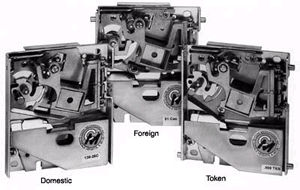
Coin Mechanisms Inc. in Glendale Heights, Illinois was founded in 1968 to make. . .coin mechanisms. Have you ever thought about what goes into a coin mechanism? It's pretty cool.
I invite you to consider the elegant sophistication of the 100 series mechanical coin mechanism. Through the use of counter-weights, magnets and "ridge detectors", this compact bit of technology can tell the difference between a real quarter and a slug.
And if you're dropping a US nickel in, it gets even fancier:
In the case of the U.S. Nickel mechanism a bounce anvil is used to test the bounceability of the coin. Due to its magnetic properties, a genuine nickel passes quickly through the magnetic field and drops off the end of the rail in an arc that causes it to hit the bounce anvil at just the right angle which, because of the coin's elasticity, bounces it into the accept slot. A counterfeit coin, passing through the magnetic field at the same speed as a genuine nickel, will not have the same hardness or bounce characteristic as a genuine nickel an dwill miss the accept slot and be returned.
These mechanisms are so tough that CoinOp says "it is possible to clean the entire mechanism by putting it in through the cycles in your dishwasher (sic)." Wow.
If you woke up tomorrow and wanted to buy one of them, you'd have to shell out. . .wait for it. . . $18.85 for the U.S. Quarter mechanism from one of their distributors. Now start thinking about what you'd want to use it for.
Like a new version of the F.E. Erickson "Ask Swami" napkin holder. More on that later.
reality: everyone is in marketing
It's more than fact sheets, and working trade shows, and journal ads.
It's more than getting your search keywords right, or writing case studies, or schwag.
At its heart, marketing is about humility: about listening first and talking later, about admitting failure and trying again, about finding problems that people will pay (in one way or another) to fix.
Which is why everyone is in marketing.
Except. . .not everyone can write clearly. Or make a compelling, succinct argument. Or weave a story. Or segment markets. Or work with the press and analysts. Or stand up in front of crowds and not talk to their slides. Or distill hundreds of features and benefits to a single, crystalline point of value that someone can look at and say yes, that's me. That's OK. They don't have to be. Someone needs to write code, balance books, keep the servers running. Marketing sure can't do those things.
But everyone involved in an enterprise focused on the creation of products that purport to solve problems needs to think of themselves as solvers of customers' problems, with the ultimate goal of holding a solution up and asking "what do you think?"
Everyone is in marketing. But not everyone can do marketing.
And that's OK too.
Because it's our job as marketers to make sure that we bring everyone along with us so they can see for themselves the wonder in customers' eyes when we get it right, and the vacant disappointment when we get it wrong.
When we bring everyone into marketing with us, we all begin to share the same sense of urgency to get it right.
And that's when everything starts to work.
It's more than getting your search keywords right, or writing case studies, or schwag.
At its heart, marketing is about humility: about listening first and talking later, about admitting failure and trying again, about finding problems that people will pay (in one way or another) to fix.
Which is why everyone is in marketing.
Except. . .not everyone can write clearly. Or make a compelling, succinct argument. Or weave a story. Or segment markets. Or work with the press and analysts. Or stand up in front of crowds and not talk to their slides. Or distill hundreds of features and benefits to a single, crystalline point of value that someone can look at and say yes, that's me. That's OK. They don't have to be. Someone needs to write code, balance books, keep the servers running. Marketing sure can't do those things.
But everyone involved in an enterprise focused on the creation of products that purport to solve problems needs to think of themselves as solvers of customers' problems, with the ultimate goal of holding a solution up and asking "what do you think?"
Everyone is in marketing. But not everyone can do marketing.
And that's OK too.
Because it's our job as marketers to make sure that we bring everyone along with us so they can see for themselves the wonder in customers' eyes when we get it right, and the vacant disappointment when we get it wrong.
When we bring everyone into marketing with us, we all begin to share the same sense of urgency to get it right.
And that's when everything starts to work.
Thursday, July 20, 2006
comment: dad on hardware
You know you've made it as a blogger when your dad reads your blog and comments.
Here's what he wrote about yesterday's "contrast: thinking about hardware" post:
Here's what he wrote about yesterday's "contrast: thinking about hardware" post:
The major issue has been cost - adding function with no revenue even with the promise of future revenue makes no sense if the function has significant cost, which can in the hardware manufacturers parlance be pennies.. therefore the only functions that the manufacturers will gladly upgrade with software are those things for which the hardware is already there. In the age of microcontrollers that's a lot more today than in the past. Also service upgrades such as call home services may be targets because the added hardware would be borne by the customer."If you own the hardware and software you can do this," he commented later on. "But once you break apart hardware and software - the whole motivation for delivering unrealized functions went away. I would think medical equipment would be the ideal candidates for this, where all the cost - like in an MRI machine - is in the magnets and the installation, and the controller and tech doing the analysis is only 5% of the cost. If can monitor licenses too. . .that would enable folks to be more free about not just delivering hardware but software that's not activated until you've got the right license. This gives you the freedom to upgrade software and hardware with a single software function, because it minimizes the risk of not getting paid."
The difference between hardware and software is gross margin, even Intel who have had the best gross margin are under pressure but software still gets in excess of 80%. Development cost are written off as incurred but manufacturing cost are in inventory and must be recovered in the price; software recovers development cost thru license rev, but since the cost are written of in prior periods the rev goes to the bottom line in terms of profit.
So once you get the initial capital to fund the development and write off the cost, the rest is mostly profit minus sg&a... so if you want to be rich start a software company.
I think your idea will work today for products that are based on microcontrollers so sort your targets by that metric.
Wednesday, July 19, 2006
contrast: thinking about hardware
I participated in a long discussion the other day about the use of software licensing tools to govern hardware functionality. For example, a given piece of medical equipment could be delivered with all functions present on the machine, but the rights granted by the software license would determine which of those functions would be available to the customer. Need to upgrade? It's a simple matter to upgrade the license.
Why am I bringing this up? I've already written about how we need to reconsider what constitutes a software "product" - thinking of it as a collection of bits that can be configured into whatever set of functions make sense for the buyer - but I'm coming to appreciate that hardware systems can be reimagined in the same way.
To the extent that licensing and audit systems can govern and report on the operating state of a given piece of hardware, there's nothing to stop manufacturers from creating and delivering a single system that can be soft configured to run in any number of different configurations.
Why don't they do it? I have a feeling it has something to do with the different mindsets of software and hardware guys.
Now, I'm not a hardware guy. My dad, Gawd bless 'im, spent his entire career in that space, but for the life of me none of his hardware wisdom seems to have made it into my software-addled head. But even I can tell that we're different animals, we software and hardware people are. Whether it's a grasp of cost accounting, time-to-market differences, tolerance for defects, whatever, we're made of different stuff. The people who inhabit the software world are. . .different. . .from hardware types.
So when a software guy started dreaming up ways to change (read:improve) how the hardware guys can think about their manufacturing process, their field upgrade process, even the very definition of what a "product" is, well, I figured it'll help to walk a few miles in their shoes first so I can understand the sorts of issues they feel are truly worth changing (read:improving).
Are there any hardware guys (or gals, for the Cranky PM) who'd care to illuminate me on the mindset of the hardware PM? How do you see yourself as different from software types? What are your processes like? What's broken in how you think about "product"?
Why am I bringing this up? I've already written about how we need to reconsider what constitutes a software "product" - thinking of it as a collection of bits that can be configured into whatever set of functions make sense for the buyer - but I'm coming to appreciate that hardware systems can be reimagined in the same way.
To the extent that licensing and audit systems can govern and report on the operating state of a given piece of hardware, there's nothing to stop manufacturers from creating and delivering a single system that can be soft configured to run in any number of different configurations.
Why don't they do it? I have a feeling it has something to do with the different mindsets of software and hardware guys.
Now, I'm not a hardware guy. My dad, Gawd bless 'im, spent his entire career in that space, but for the life of me none of his hardware wisdom seems to have made it into my software-addled head. But even I can tell that we're different animals, we software and hardware people are. Whether it's a grasp of cost accounting, time-to-market differences, tolerance for defects, whatever, we're made of different stuff. The people who inhabit the software world are. . .different. . .from hardware types.
So when a software guy started dreaming up ways to change (read:improve) how the hardware guys can think about their manufacturing process, their field upgrade process, even the very definition of what a "product" is, well, I figured it'll help to walk a few miles in their shoes first so I can understand the sorts of issues they feel are truly worth changing (read:improving).
Are there any hardware guys (or gals, for the Cranky PM) who'd care to illuminate me on the mindset of the hardware PM? How do you see yourself as different from software types? What are your processes like? What's broken in how you think about "product"?
Sunday, July 16, 2006
half-review: the e-myth revisited
I'm about halfway through Michael Gerber's The E-Myth Revisited. It would have made an ideal beach book. It also qualifies as an excellent book of business pr0n (wrong definitions, right definition).
Which I mean with all respect. After all, it's accessible, it's episodic, it's full of big themes, it's light on substance, and it's not strong on dialogue. But I digress.
Mr. Gerber's central thesis that you should work on your business, not in your business, is certainly an valid point. As is his point that most small businesses are most often created by expert "technicians" who, in an entrepreneurial spasm, decide to go into business for themselves and who fail in the vast majority.
As a PM, the part I'm taking away for further review is his idea of the "franchise prototype". Hideously simplified, this idea goes like this: if you had to create 5,000 businesses like yours, each of which must operate identically, how would you go about creating that prototype?
Beyond the software you create, what aspects of your business would you target for innovation? How would you quantify the impact of that innovation? And how would you go about orchestrating the consistent execution of that innovation?
The reason I'm going to need to work on this some more is my concern that there are few if any elements inside of a modern software company that are consistently quantified and orchestrated for consistent repetition. Other than tracking sales.
Which I mean with all respect. After all, it's accessible, it's episodic, it's full of big themes, it's light on substance, and it's not strong on dialogue. But I digress.
Mr. Gerber's central thesis that you should work on your business, not in your business, is certainly an valid point. As is his point that most small businesses are most often created by expert "technicians" who, in an entrepreneurial spasm, decide to go into business for themselves and who fail in the vast majority.
As a PM, the part I'm taking away for further review is his idea of the "franchise prototype". Hideously simplified, this idea goes like this: if you had to create 5,000 businesses like yours, each of which must operate identically, how would you go about creating that prototype?
Beyond the software you create, what aspects of your business would you target for innovation? How would you quantify the impact of that innovation? And how would you go about orchestrating the consistent execution of that innovation?
The reason I'm going to need to work on this some more is my concern that there are few if any elements inside of a modern software company that are consistently quantified and orchestrated for consistent repetition. Other than tracking sales.
gear: eurita strandkorb beach chair

Running down my list of national stereotypes, right after "The French Make Great Cheese" and "The Polish Make Great Variety Meats" is "The Germans Make Great Beach Chairs."
If your list reads differently, cast your reclining eyes on this beauty and get ready to be convinced. The Eurita Strandkorb isn't your carry-on-your-shoulder beach chair - it's hundreds of pounds of finely crafted furniture which can be called "portable" only because it has handles. The Bismark of beach chairs, this monster comes in a variety of sizes, but all of them feature the following:
• 2 pillows and 2 neck rolls and 2 folding side tables
• Weatherproof awning fabric
• Heavy-duty cover option
• Extra-thick cushions
• Full 90° recline capability
• Slides or wheels for mobility
You can view the entire line at Reston Lloyd's website by typing in Strandkorb in the upper-left select box and "contains" in the box below it.
And should you find a few grand burning a hole in your lederhosen, you could buy one here (Costco, of all places) or contact their North American sales representative Tom Grubisich at (310) 917-1197. The Eurita Strandkorb "King" (shown here) was being offered at a 20% discount at one point ($3,920 from $4,900, plus shipping). Ach mein liebe!
Saturday, July 08, 2006
poll: the mount rushmore of pie
It's summer. I've been away "on holiday" now for a week, and I can strongly recommend the experience to all PMs, especially the Cranky PM (thanks for the link).
This evening, we grilled divers proteins (chicken and shrimp) which we served with noodles (with butter for the kids and pesto for the grups) and assorted blanched veggies. Then came the surprise.
Pie.
Peach pie, to be specific.
Now I won't turn down peach pie. If you've gotten a good long look at me lately, you might add that I don't turn down many meals. But I'm a bit of a stickler when it comes to pie.
We went around the table and named our "Mount Rushmore of Pie" - our individual "top 4" pie selections.
Here's mine:
1. Blackberry - The God-Emperor of Pie. Nothing is more perfect than Blackberry Pie.
2. Coconut Custard - A seasonal favorite, this beauty tastes of the coming of the Christ Child and Santa, in that order.
3. Lemon Mirangue - This beauty has two lives: the first at the table, the second enshrined in the fridge with a fork stuck in it.
4. Mincemeat - Rarely seen, and often done poorly, the exceptional mince pie is a thing of beauty. Suet optional.
Since all PMs love pie, I'm curious which ones you'd enshrine on your Mt. Rushmore of Pie.
And for G-d's sake, take a vacation.
This evening, we grilled divers proteins (chicken and shrimp) which we served with noodles (with butter for the kids and pesto for the grups) and assorted blanched veggies. Then came the surprise.
Pie.
Peach pie, to be specific.
Now I won't turn down peach pie. If you've gotten a good long look at me lately, you might add that I don't turn down many meals. But I'm a bit of a stickler when it comes to pie.
We went around the table and named our "Mount Rushmore of Pie" - our individual "top 4" pie selections.
Here's mine:
1. Blackberry - The God-Emperor of Pie. Nothing is more perfect than Blackberry Pie.
2. Coconut Custard - A seasonal favorite, this beauty tastes of the coming of the Christ Child and Santa, in that order.
3. Lemon Mirangue - This beauty has two lives: the first at the table, the second enshrined in the fridge with a fork stuck in it.
4. Mincemeat - Rarely seen, and often done poorly, the exceptional mince pie is a thing of beauty. Suet optional.
Since all PMs love pie, I'm curious which ones you'd enshrine on your Mt. Rushmore of Pie.
And for G-d's sake, take a vacation.
Saturday, July 01, 2006
collected: assorted at an airport
There is a curious kind of calm that overcomes me when I start a "vacation" - I know it won't last, that in the blink of an eye (mine) I'll be back in the s@$!, but for that one fleeting moment, I'm able to get a taste of what it must feel like to be at peace. It's the hollow between big waves, that instant when your toes settle back down to the sand before the next wave hits.
I will be dropping in observations and other oddmentia that have been piling up, but let's start with one that's been puzzling me of late.
The world of modern slotcar racing is dominated by four firms, primary among them Scalextric and Carrera. They make the familiar modular track and scale cars (1/24 and 1/32 being the most popular).
These individual track segments are not cheap, running into $20 and up each.
The hobby is not as popular in the States as it is in Europe, especially Spain, BTW.
With these price points in mind I was surprised to discover a vendor who decided to go counter to the prevailing track-segment modularity to sell entire table segment modules of track that can be assembled. Slotfire (http://www.slotfire.com) is turning an industry on its head by challenging one of that industry's fundamental assumptions: that tracks are assembled from individual track units.
It's a cool concept. Expensive, but very cool. Is is just for the high-end? Or will it begin the process of redefining a market?
I like to see disruptive product concepts like this that challenge our assumptions of what is normal and expected, opening our eyes to radical new possibilities.
I will be dropping in observations and other oddmentia that have been piling up, but let's start with one that's been puzzling me of late.
The world of modern slotcar racing is dominated by four firms, primary among them Scalextric and Carrera. They make the familiar modular track and scale cars (1/24 and 1/32 being the most popular).
These individual track segments are not cheap, running into $20 and up each.
The hobby is not as popular in the States as it is in Europe, especially Spain, BTW.
With these price points in mind I was surprised to discover a vendor who decided to go counter to the prevailing track-segment modularity to sell entire table segment modules of track that can be assembled. Slotfire (http://www.slotfire.com) is turning an industry on its head by challenging one of that industry's fundamental assumptions: that tracks are assembled from individual track units.
It's a cool concept. Expensive, but very cool. Is is just for the high-end? Or will it begin the process of redefining a market?
I like to see disruptive product concepts like this that challenge our assumptions of what is normal and expected, opening our eyes to radical new possibilities.
Subscribe to:
Posts (Atom)