Saturday, December 31, 2005

wondering: what the &*$! is Web 2.0?

I've been through my share of meme-shifts. When I was at Sybase we had our uncarriages in a twist over the "Object-Oriented Database" thang. Anyone of a certain age remembers the CASE tool fad. And who doesn't get a little frisson of angst when they look back on the gold-rush that took place around Pointcast and the first version of Marimba?

So it is with a certain sense of deja vu that I find myself reading more and more about something called "Web 2.0", which I shall arbitrarily abbreviate "W2", for it is New Years Eve and I am lazy.

The canonical source of truth describes W2 as:
". . . a term often applied to a perceived ongoing transition of the World Wide Web from a collection of websites to a full-fledged computing platform serving web applications to end users. Ultimately Web 2.0 services are expected to replace desktop computing applications for many purposes."
Well gosh, this is a mighty ambitious thing, this W2. As we've seen before, there's no sense of doing something if you don't do it big. But this time, le meme du jour is accompanied by some pervasive facts that are visible to the washed and unwashed alike.

We can see newspaper circulation numbers plummeting faster than a paralzyed albatross. We can read unedited, unexpurgated and unverified "news" at any hour of the day from armies of bloggers, yours truly included. And we can experience the dizzying growth of cheap, easily accessible broadband combined with cheap gigahertz-class computers and utterly ubiquitous mobile telephony.

However you elect to mix these things together, they describe a fundamental shift in the "content computing platform". We've gone from mainframe to midrange to desktop to network "computing". The trick is, we're in the transition phase between desktop and network computing, waiting for the core enabling technologies to reach the tipping point.

We may have RSS "mashups" and AJAX and Google Earth extensions, but we're not using web services as substitutes for "regular" applications. Yet. We're not leveraging unused MIPS in our "neighborhood group" as a sell-back utility to corporations. Yet. We're not seeing a rich-media RSS experience that spans desktop/mobile/palmtop.

(Sing with me)

Yet.

From where I'm sitting, the software that gets developed to exploit and extend this platform seems to be in its infancy, lolling in the cradle with wide eyes and moist diapers.

It is going to be a fun year for professional software marketing guys, because as the meme shifts from emergent to urgent, we're the ones who are going to wrap it, position it, package it and sell it. We're going to take it from something that makes sense to the few and transform it into something that makes sense to everyone. Whether we do it for commercial providers or shared/open-source cabals, the skill set of folks who sit on the narrow divide between engineering and sales is going to be in high demand. Software braintrusts build the bullets, sales shoots them, but we aim.

Thursday, December 29, 2005

favorite: fortune cookie quotefiles

[UPDATE - All of these fortune cookie quote files can be found at this newer post. Continue reading here for all of the back-story.]

End-of-quarter craziness has left me officially crispy. And so, rather than opine on the mysteries of product marketing, I will share one of my "favorite things" as my New Year's gift to you.

Back in the day, I discovered the fortune program whilst fiddling around on my first UNIX system. Flush with wonderment at the ability to extract a fresh quote from some hidden store of wisdom, I applied what limited brainpower I had and came up with a way to insert a random quote into my finger file from a quotefile of my own design. This made me feel rather clever, I'll have you know.

Step ahead to 2005, and I still need my daily dose of randomness; you'll note that I've implemented a rudimentary Quote of the Day up on the upper right hand side of Ack/Nak. For Windows, however, there isn't a better (free) fortune cookie program than Catfood Fortune Cookies, because you can extend it with quotefiles of your own. It enjoys pride of place in my Startup folder next to Konfabulator, Serious Samurize's Milk Weather Suite, and ObjectDock.

So here are a few of my favorites.

(Note: These are collections of quotes from many, many third-party sources, provided here on an as-is basis in flat ASCII txt files. If you object to my distributing them, let me know. The comments associated with each file are posted here purely for my amusement.)

FC/TAG - a variety of quotes culled from ancient sources - the MSDOS FC.EXE program (lifted with the help of Norton's Diskedit) and the Quote of the Day program from the TAG BBS. These date back to 1988 and the well-loved PS/2 mod 30-286 that the Swamp Witch escaped with.

Hack Rumors - Hack has a fortune cookie program built into it which provides players with fortune cookies. Good to eat and full of pithy wisdom, this goofy find will appeal to old-time D&Ders.

HAL9000 BBS - a *huge* collection of taglines was found on the HAL9000 BBS in Ann Arbor sometime in late 1993, which after monsterous effort was transformed into a useful quotefile. I think.

ILLUMINATI BBS - The Illuminati BBS had the MACRO.EXE quote generator set up for their Quote of the Day, and this was the default quotefile. This collection of quotations, character art, and folk wisdom is copyright 1991 by Robert M. Schroeck. Copyright on individual items may still be held by their original owners.

STEVE JACKSON GAMES - Steve Jackson Games' Illuminati BBS had a section called 'G-files' where various and sundry stuff was put to pasture. These were culled and formatted between 1992 and 1993 during SQL runs. This file also includes SJG's Famous Last Words (FLW) collection.

MST3K - Mystery Science Theatre 3000 quotes and comments from the 'bots (Gypsy, Tom Servo and Crow T. Robot), Joel Robinson, Mike Nelson and the Mads (Doctor Clayton Forrester and TV's Frank). The nice folks on alt.tv.mst3k made it all possible.

SUNOS FORTUNE - Lifted from the Sun Release 4.1 (88/02/16) version of FORTUNE. Apparently this program took its adages from a datafile in sequential order, making it vulnerable to:
#! /bin/sh
#
echo "%" > f
for counter in `jot 4000`
do
/usr/games/fortune >> f ; echo "%" >> f
done
The first line of the dumpfile was used to test for rollover in vi. This last of the big-time quotefiles was taken on 01/27/94.

MOTD BOB - this series of quotes/thoughts/stuff was compiled over a period of two years at Compuware from USENET, Japanese, talk.bizarre and other assorted sources. Included in this file are the following small datafiles:

Wednesday, December 28, 2005

idea: ClickOnce and RSS

One of the whiz-bang features we put into InstallShield 11.5 was support for ClickOnce; both for creating ClickOnce installations with InstallShield and for converting ClickOnce installs into MSI. Neat.

For the uninitiated, here's MSFT's description of ClickOnce that you can say with your mouth full of food:

ClickOnce, part of version 2.0 of the Microsoft® .NET Framework, allows you to deploy Windows-based rich client apps to a desktop by placing the application files on a Web or file server accessible to the client and providing the user with a link. (source)

But when I stepped back and looked at ClickOnce from 10,000 feet, I began to see some opportunities for connecting the pipe (RSS) to rich content on the pipe. To the extent that some of that rich content may require specialized client software to present it, providers will need to figure out how to get that client software onto their reader's machines in a safe and scalable way.

One reason that ClickOnce works as a packaging and delivery mechanism for individual content is that it operates in a secure sandbox provided by .NET code access security (which you'd know if you'd read the article referenced above). This is a level of security that administrators like.

Rate-limiting factors are, of course, the presence of the .NET framework on your reader's computer, and the fact that ClickOnce won't really come into its own until Vista ships - at that time, ClickOnce-packaged code will be able to (according to MSFT) "trickle-feed" update of files in a way that is less obtrusive to the user. That way if you deliver some executable via ClickOnce that is used to enhance your RSS content, you can update it in the background independently.

Right now, ClickOnce looks good for delivering richer forms-based panels and whatnot via browsers. Who knows what it'll be good for later in 2006. But whatever it is, it's a nice lightweight, secure packaging technology that might yield some good synergies with content you want to deliver via RSS.

rant: fabricated vs earned buzz

My copy of Advertising Age finally made it up to my desk from the nether regions of the mailroom, and what do I find but an article by Larry Dobrow (AA 11.28.05 p33) titled, "Play to passions of adults, use events, experts urge". But it's really about buzz tactics.

From my time spent at Torre-Lazur/McCann Global a few years back, I know that clients like to see buzz marketing tactics in the mix. They like to see targeted websites, forums, peer group discussions and other whatnot that simulate "real people expressing their heartfelt opinions to the unconverted".

I also know trying to talk clients out of these fabricated attempts to create buzz can be difficult, because clients want to do everything they can to guarantee a fabulous launch. In his article, Larry quotes Patti Saitow, Radica's VP of global marketing services as saying, "I was surprised [the buzz effort] worked. the campaign felt very genuine to us, and I guess consumers picked up on that."

The reason I'm re-quoting Patti is that she (perhaps accidentally) struck on the reason why I'm not a fan of fabricated buzz tactics - they feel genuine, but they're not genuine.

In all fairness, however, fabricated buzz campaigns do work - the same way burning down all of the wood in the forest around your cabin works to heat it. But eventually, you run out of wood, then the mudslides come. . .and the killer weasels. . .

Fabricated buzz is like lying about your age. Sooner or later, the truth will get out and you'll end up looking like an ass. Sooner or later your customers realize that they've been manipulated by someone close to them, and they'll take out their frustration first on your product - and next on the person who tried to sell them the product.

The doomsday scenario is this: fabricated buzz tactics will - if used extensively - create a cynical, suspicious consumer who is even less "open" to product marketing than before, and this includes genuine buzz. It's a scorched earth tactic that is bad for the marketplace.

Generating genuine buzz around a product launch is hard work. You can't hire "buzz specialists" to do it for you. More simply, you can't buy buzz - you have to earn it. Nowhere is this more true than the commercial software marketplace.

You earn buzz around software by creating a truly excellent product, with credible, clean positioning, reasonable pricing, and by backing it up with service. You earn it by sharing it with groups of users, by talking to editors, by doing anything you can to get the word out that you've got something different that works better.

You don't need hired minions to chat up your product. Let your product do the talking for itself. If you've done your job, it will speak for itself better than you ever could. That's when true word-of-mouth takes over, and that's earned buzz.

Tuesday, December 27, 2005

discussion: the tao of pricing vs the te of discounting

One of the wonderful things about being a product marketing guy is being able to get my hands dirty with pricing. Especially this time of year, when the tao of pricing is accompanied by the te of discounting.

If you're not familiar with these concepts, go read the Tao of Pooh and the Te of Piglet entries over at Wikipedia. I'll wait until you come back. You may want to bounce over and read the entry for Taoism for extra credit.

Te - which I'll interpret here as signifying "virtue" - is a principle very diffferent than Tao - which I'll interpret here as signifying "the way".

I'm thinking about this because I just got the following request from sales: "a very important customer (ed: they're all very important, but let's not digress) has asked for a discount on product x amounting to our 'best price' for this particular product, even though they're not buying at the volume required to get this 'best price'."

Of course, "very important customers" are entitled to ask for discounts. Smart sales people are trained to remind such customers of the "value" of the products being sold, and to reiterate the "fairness" of the price vis-a-vis the value delivered. Welcome to Rug Merchant Haggling 101.

But for those folks who are actually charged with coming up with pricing, this transaction looks different. The way I see it, something is broken with pricing that creates friction. When faced with pricing that is out of phase with the market, one way to address it is discounting. This is not the optimal response, but sometimes the necessary one.

The preferred approach is to be aware of pricing at all times - to be constantly mindful of how the true value of your product is perceived by customers. If you are always watching pricing, it is a "way" - it lives - and living things are always more adaptable than dead ones. Customers respect pricing that makes sense, as do sales reps. They have enough problems without having to constantly explain broken pricing.

So when a customer requests a discount over and above what is described in your pricing, you are called upon to exercise virtue - to contemplate the value of this customer to your business, and to use the act of discounting to deepen your relationship, even at the expense of immediate gain.

(Coda: my response to the sales rep was to ask her to tell me more about this customer and our relationship with the customer. If we're going to extend them a discount, there must be value to it, and the granting of the discount must be interpreted as a sign of good intentions on our part - of virtue - of Te.)

Monday, December 26, 2005

requirements: a good bag for your essentials


If you're going to be schlepping all over the planet, you're going to need a good bag.

Why? Because you're going to need to keep some aspects of your personality close at hand during your travels. While your suitcase will be ritually abused by baggage handlers and your computer case will never see the light of day outside your hotel room, your bag will go everywhere you go. It is an extension of you the same way your del.icio.us tags are an extension of you.

Here are the essentials I need nearby whether I'm trapped in an airport or abusing espresso in a Paris cafe:

1. Filofax Slimline organizer - I've run through so many different ways of capturing data over the years that I've lost count. I like the size and quality of Filofax papers, so there you are. When I start a page, I tag it and date it at the upper right; later on, I'll archive pages into a larger organizer that is part scrapbook, part research library.

(Note - for those of you hooked on Moleskine notebooks, ask yourself how you'll gather all the notes you've taken on a particular topic together from all the various notebooks you've got. QED.)

2. Digital camera - Sony Cyber-shot is the shiznit.

3. A bottle of water - because you never know.

4. Your phone - I'm lucky to use a Treo 650 that my employer has conveniently hooked up to my Outlook mail and calendar. My thumbs are mighty and fast indeed.

5. Nintendo DS (formerly a PSP) - A man has to get his Mario on. The DS (especially the DS lite) is rugged, has good battery life, and lends itself to occasional usage. I recommend Mario Kart DS, Electroplankton, New Super Mario Brothers and Mario Pinball (GBA).

6. Book of the hour - Paperbacks are easier to transport than hardcovers. I just finished Snowcrash for the n-th time. Next up, Flamesong by MAR Barker.

7. 2"x2" origami papers - whenever I'm particularly stressed, I make tiny origami cranes and leave them in incongruous places as little mitzvahs for the unsuspecting.

8. "Scotch and Soda" coin trick - because you never know when you'll need to win a drink in a bar.

9. Rotring automatic pencil / replacement leads / Staedtler Mars plastic eraser in a beat-up plastic MSFT gimme pencil case - my writing implement of choice.

10. Deck of cards

11. Small squeeze bottle of hand sanitizer

12. Small package of tissues - can do emergency double-duty as toilet paper.

13. 2GB iPod Nano

14. Rosary beads / worry beads / chaplet - keeps your hands busy and your mind still

15. Rhodia Pad 11200 - this is usually in my pocket too; it's essential for quick notes, sharing info, whatever. If you've never used Rhodia pads before, try this size out. It fits in most of those "flip pad" covers you get at tradeshows.

16. Local subway map - because the best way to see a city is to wander it like a local.

17. A few bags of peanuts - they help when you hitchhike with the Vogons.

18. Sunglasses

19. Tin Whistle - a man has to practice. Depending on my mood, I'll bring my Parkhurst, Burke, Sindt, or my low A Copeland.

20. An Opinel knife - not airport safe, but damned useful to have around.

21. One (1) Connemara marble worry stone - because I worry.

22. Mints/gum/whatever kills the evil taste of disappointment and regret.

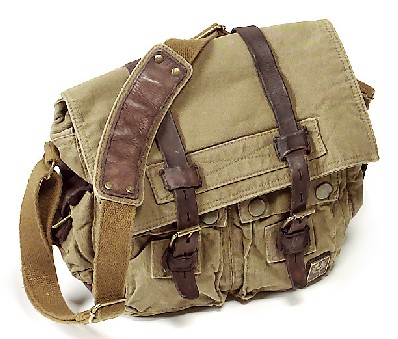
Santa brought me a Belstaff Colonial Canvas Collection shoulder bag ("as seen in the movies 'The Interpreter' and 'Batman Begins'") - which beats the tar out of the SoftSummit gimme bag I've been using.

What do you carry with you?

Saturday, December 24, 2005

read: Counting Heads by David Marusek

Fellow Blogger David Marusek's debut novel Counting Heads is terrific. I'll not try to top the review Cory Doctorow wrote for Amazon, but I will add my USD$0.02.

Do you remember the feeling you had when you read Neuromancer for the first time? The feeling of abandonment, of being entirely swept away not only by the narrative but by the concept behind the novel?

OK, take that feeling, add characters you can actually sympathize with, and you've got Counting Heads. Everyone except the affs are human, and that's no different than the real world, IMO.

The fact that it takes place in Chicago is a bonus worth noting. Bears.

tenet: one thought per slide

Back when I got my first product management job, I thought I had some pretty good presentation mojo. And why not? I was reasonably engaging, animated, I could work a crowd, I could think on my feet. I had a point of view, and a compelling point to make. And I thought I displayed utter command of my material by sharing volumes of source data on my slides.

But after a few years in the game, I learned that. . .that. . .

My presentations sucked. I was killing my audience with dense, impenetrable slides that stunned them into a stupor of near-mythic quality.

It's hard not to share the information you've worked so hard to find. But it's even harder to distill all this data into information, then distill it further into something that is actionable and compelling.

I've come to appreciate that creating a good presentation is a lot like creating a good stock - start with good ingredients, then boil it down. Stay on top of your seasoning, and filter out the nasty bits when you're done.

The zen master of pitch-fu, in my opinion, is Mr. Jobs - you owe it to yourself to watch one of his keynote addresses, in which you'll see him put up slides with a single word on them. Or a single graphic. Or a short phrase.

One thought per slide can be done, but only if you've got your story absolutely clean and you've mastered the flow of your pitch.

Avoid the urge to vomit on your slides. You're not Charles Dickens - paid by the point. You're writing a short story, which, as we all know, takes longer to write than a long one.

Friday, December 23, 2005

tip: "Me See" is your friend

I was thinking about this ever since writing about Feedburner last night. No one will argue that you need to know who your customers are. Figuring this out can be surprisingly difficult, especially if you have to confront "popular wisdom" held by the senior managers/founders/money guys who already think they know who your customers are.

An easy exercise for exploring this is to pretend that you're a freshly-minted new associated at McKinsey. Sit up straight in your cube and say "Me See". Ignore your cube-neighbors when they accuse you of imitating a bad 50s era asian movie stereotype, and say "Me See" again. Doesn't that feel smart?

Me See, or MECE, stands for "Mutually Exclusive, Collectively Exhaustive", and it's a principle you need to keep in mind when the time comes to describe the taxonomy of your target market.

Start at the top with the largest possible group of potential customers. If you were selling the canonical bag of chips, you might start with "people who eat". You'd have to conclude that some people who eat aren't going to eat chips - children under 2, for example. So below "people who eat" you'd create two groups: "Children under 2" and "People older than 2". Congratulations, you've segmented your market.

Keep segmenting that target audience until you've arrived a sub-grouping of your market below which it doesn't make a lot of sense to go. Think demographics, psychographics, and other inclusive/exclusive qualities, then see how your target market breaks up.

For a complete rundown on how McKinsey does this, go buy Ethan Raisel's book The McKinsey Way.

I used this technique earlier in 2005 when I looked at the target market for installation tools. No matter how I sliced it, the opportunity wasn't getting bigger. So I looked at it another way - what would happen if our target market wasn't just "people who write installations" but "people who write software"?

(For those of you scoring at home, this is working MECE from the opposite direction - instead of top -> down, I looked at it bottom -> up. Same concept, though.)

The result was a concept for a new product designed for application developers - they may not write the installation, but they sure do have a hand in it, since they are the "keepers" of installation requirements. Give them a way to capture these requirements, and make it easy for the installation guy to incorporate the requirements into the install, and viola, you should have a no-brainer of a line extension that could actually make life easier for anyone who produces software.

Decide for yourself if it makes sense. Then go back and look at how you've defined your marketplace and see if your "traditional" way of defining your customer base merits a fresh "me see" look.

For the record, if you're not constantly challenging how you define your market - and how your market defines you - then you'd better find another line of work.

Thursday, December 22, 2005

observed: feedburner

Feedburner is a very, very clever concept. I use it, you should too. If you happen to be blog-prone, of course.

First, they've got stats nailed. That's probably their most notable secret sauce. RSS readers are dead-easy to code, unlike browsers, but there are all manner of ways that RSS feeds get consumed - in Firefox, behind aggregators, by bots. Making sense of feed traffic is deep voodoo, and by gum, I think they've got it.

Second, they've made using their product dead easy. I'm only a few short rungs up the evolutionary ladder from a lemur, and I could do it. Now, with the merest few clicks of the pointing device, I can revel in all manner of information regarding the masses of subscribers who have flocked to ack/nak for their daily dose of (whatever).

And finally, they are right at the heart of the next wave of the media consumption gestalt - individuals, comme moi, want to consume "news" the same way we now consume music - one track at a time. RSS feeds are consumed in a way email is not - they aren't subject to the same filters that sift through spam. A feed is something you choose, and once chosen, it offers you even more choice. The feeds I consume on a daily basis are as a constant cascade of the freshest newsprint, delivered one story at a time. Feed to index to content, in one swoop.

How much more indicative of an individuals preference are the feeds they read, as opposed to the words they search on? It's the ultimate intersection of content, advertisers, and consumers.

It's a swell business plan, run by some swell people, at *exactly* the right time.

So they won't mind when I advise that they clean up their website, streamline their subscription process (SET SHATNER=ON; "Too....many....choices..."; SET SHATNER=OFF), and tighten the way they articulate their value proposition to a short sentence that can be repeated with ones mouth full of food.

Now that delicious and flickr and konfabulator have fallen to Yahoo! Borg, Feedburner remains one of the last bastions of the blogostructure still sailing with an independent hand on the tiller and with its top gallants full of wind.

Nice.

rant: the nobility of the software merchant class

This has been a good week for getting Out of Office autoresponses. Which I find incredibly odd, given that it's the end of the quarter and the end of the fiscal year. And so, I reflect on the essential nobility of the software merchant class, which I fear is not only at risk of being lost, but of being trampled underfoot, eaten by feral pigs, and crapped out in the dead leaves next to the highway.

Maybe I'm just a nut, but can't you take vacation when it counts less? Don't you realize that this is exactly the time when your presence in the office counts most? Didn't it occur to you that *now* is when customers are asking the hard questions, choosing between options, flushing budgets, making decisions? Spending money?

Sure, you have a fancy Treo 650 that tethers you to your email and anyone who would care to talk to you. But You're Not At The Office Where Customers Would Expect You To Be.

We're software merchants. We code it, test it, burn it, box it, take orders, ship it, support it. It's a product that solves problems the same way a loin of pork does, or a new coat does, or a new hose does. We just make our product out of air, and dreams, and daring.

And now, when it matters most, we need to stay close to the till, because that's what we do. Because if we're not there, we're just a box store moving bales of paper towels and cubic yards of trail mix.

Wednesday, December 21, 2005

ACK/NAK Defined

ACK /ak/ interj.

[from the ASCII mnemonic for 0000110]

1. Acknowledge. Used to register one's presence (compare mainstream *Yo!*). An appropriate response to {ping} or {ENQ}.

2. [from the comic strip "Bloom County"] An exclamation of surprised disgust, esp. in "Ack pffft!" Semi-humorous. Generally this sense is not spelled in caps (ACK) and is distinguished by a following exclamation point.

3. Used to politely interrupt someone to tell them you understand their point (see {NAK}). Thus, for example, you might cut off an overly long explanation with "Ack. Ack. Ack. I get it now".

There is also a usage "ACK?" (from sense 1) meaning "Are you there?", often used in email when earlier mail has produced no reply, or during a lull in {talk mode} to see if the person has gone away (the standard humorous response is of course {NAK} (sense 2), i.e., "I'm not here").

NAK /nak/ interj.

[from the ASCII mnemonic for 0010101]

1. On-line joke answer to ACK?: "I'm not here."

2. On-line answer to a request for chat: "I'm not available."

3. Used to politely interrupt someone to tell them you don't understand their point or that they have suddenly stopped making sense. See ACK sense

4. "And then, after we recode the project in COBOL...." "Nak, Nak, Nak! I thought I heard you say COBOL!"

(Source: The Hackers' Dictionary of Computer Jargon)


ACK: "I get it."
NAK: "I don't get it."

(Source: Me)