Tuesday, September 26, 2006

shift: the saas siren

Encyclopedia Mythica tells us this about the Sirens:
In Greek mythology, the Sirens are creatures with the head of a female and the body of a bird. They lived on an island (Sirenum scopuli; three small rocky islands) and with the irresistible charm of their song they lured mariners to their destruction on the rocks surrounding their island (Virgil V, 846; Ovid XIV, 88).

Delightful. So let's go back to the beginning.

The more I learn about Software as a Service (SaaS) the more I hear the Sirens. That's because their singing the buzz is building in volume every day - certain high-profile VCs are "only investing in SaaS" vendors. . .there are "SaaS Conferences" galore. . .you can't open a trade rag without seeing it. . .new analyst papers are popping up daily. This isn't "this year's object-oriented database" fad. . .it's serious. And disruptive as all hell to the "traditional software model" in which ISV A writes software that is packaged, delivered and installed by Company Z, for which they pay a one-time perpetual license fee and annual maintenance fees.

Let's take it as read Company Z would rather not pay a big chunk of change for certain sorts of software. Add the allure of Company Z being able to obtain access to the capabilities of ISV A's solution without having to invest in all of the people, hardware and networks required to operate that solution. Add to that the sizzling allure of Company Z having the option to buy just what they need, when they need it, and stop using it when they stop wanting it. It gets pretty compelling.

For ISV A, the attractions are equally interesting, but the challenges of delivering are far beyond what they've ever needed to address. They have to worry about maintaining service levels, more frequent release schedules, a greater focus on service, different sales compensation schemes, more urgent competitive pressures, and a sea-change in revenue streams from quarterly to monthly with no cushy maintenance stream to fall back on. . .

My management tells me to be to the point, so I'll sum it up like this: ISVs think they can make more money selling their software as a service, and they think their customers would prefer to consume it that way. Neither side entirely understands the implications of this in the long term.

Yes, you probably knew this already.

Monday, September 25, 2006

observed: boxxet (redux 1)

I've been a big fan of Boxxet since late March when I got my beta invite and started banging around the site. In the last few months You Mon Tsang and his team have been making dramatic improvements to the user experience, the back-end server, the AI and most of all, the quality of the Boxxets (pron. "Box Sets").

I've been getting a number of comments lately from folks looking for a beta invite, of which I still have a number. If you want one you need to email me - leaving an anonymous comment doesn't give me a way to get you the invite. Thanks.

willingness: the credibility catalyst

I attended a workshop last week at which one of the speakers. . .spoke. . .at length on the topic of "how to market your SaaS company". Fascinating stuff. Distilled to its crusty essence his message was "SaaS is a cash-flow business that demands different approaches to sales, marketing, development and ultimately service."

I can buy that. Especially the service element, but not in the traditional way we think about service.

Let's start by agreeing that all we want - all anyone "in the marketplace" wants - is to know that for any given problem/desire/need we have, that somewhere out there is a provider who is experienced/credible/willing to help us "service" that need.

In this regard, I see service less as "how fast do I answer the phone and close support incidents" and more as "how well do I willingly project my credible experience into the marketplace." The trick is that while experience begets credibility, credibility doesn't beget willingness. You need a culture of willingness from the beginning - it is the invisible delivery catalyst.

We all know when we meet someone who sincerly wants to help us solve a problem. You decide if they're credible, a quality you gauge based on objective (and often subjective) measures of their experience.

It may seem almost foolishly axiomatic, but I think it's the subjective measure of willingness that seals the deal when choosing between equally credible, experienced alternatives. We respond to that spark of curiousity, of caring, that tells you "I'm listening." It's a very human quality that can't be enforced or bought.

In a cash-flow business like SaaS where you have to earn the customer's business on a month-to-month basis, a failure to engage the customer openly, honestly and above all willingly spells death.

But if that quality of willingness is the critical success factor, how do you test for it? You can interview for experience, you can check references for credibility. How do you hire a team that you know will willingly engage the customer day after day, week after week?

Do you know how? Because if you don't have that team, you're going to fail. Especially if you're counting on actually collecting some money for each of those 78 monthly billing cycles instead of just the yearly maintenance renewal and the end-of-quarter perpetual license fees.

Sunday, September 24, 2006

Friday, September 22, 2006

list: depression hurts. . .

your dog.

your credit rating.

your mileage.

your odds of being nominated for "Queen of May".

your bitchin' Camaro.

your genetic material.

your mojo.

your Grranimals.

your new Blythe doll with the hand-sewn jacket and boots and totally minty hair.

your sense of smell.

your back-hand smash.

your ability to bluff.

your CPR certification.

your deliciousness.

your Christopher Walken impression.

your Blue Eyes White Dragon deck.

teh 1337 pwnage, noob! (a.k.a "depression sux0rs my nux0rs")

your whole enchilada.

your bling.

your auld granny.

your ding-a-ling.

your ability to recognize marketing.

(To Eli Lilly, makers of Cymbalta: Your ad agency - who I think is GSW Worldwide - should get full credit for working hard on your behalf to find a novel way to push a run-of-the-mill selective serotonin and norepinephrine reuptake inhibitor that just happens to be indicated for the management of diabetic peripheral neuropathic pain. Preying on people with depression is one thing - we all know that the switch rate between SSNRIs and SSRIs is super high, so you're probably just working to get your piece of the action - but trying to draw a causal link between serotonin/norepinephrine imbalance and diabetic peripheral neuropathy is just, well, typical of something an ad agency would think of to win your business. I'm counting the days until you start connecting incontinence with depression. Or perhaps you can pick some of my ideas.)

Tuesday, September 19, 2006

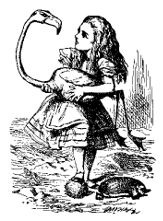
croquet: a software marketing allegory


Let's say you and your buddies want to play croquet. You dig out your croquet set, then think about where you're going to play.


One friend suggests building a croquet lawn and proposes the following:

"The construction and maintenance of a croquet lawn is no simple matter. Once we have identified a suitably large rectangular expanse of dirt measuring 35 yards by 28 yards, we'll need to see to it that the expanse of dirt is levelled, provided with sufficient drainage (perhaps with alluvial sand), raked clear of stones, seeded or turfed, and then watered. We will, of course, need to consider issues of soil porosity when crafting the drainage strategy. Having constructed our lawn, then depending on the season, we'll need to consider the following essential activities:

  • Autumn: Scarification & Thatch Collection; Surface Repair; Aeration; Worm Killing; Application of Fungicide & Moss Killer; Feeding, Top Dressing, Over-seeding and Mowing the Lawn.
  • Winter: Mowing the Lawn; Brushing & Applying the Dragmat; Application of Fungicide
  • Spring: Rolling (if flat and level to start with); Scarification & Thatch Collection; Feeding; Aeration; Worm Killing; Applicaiton of Fungicide & Moss Killer; Mowing the Lawn.
  • Summer: Mowing the Lawn; Scarification & Thatch Collection; Irrigation; Weed and Worm Killing; Aeration; Application of Insecticide

"We'd want to buy a good cylinder mower," he might add, "Because while your mower may have three or four helical blades on the cylinder, for croquet lawns it's good to have 10-12. You'll get better results and that nice striped cutting pattern. Then we can call Jacques America for better equipment, because you won't want to use that. . .that nasty shabby set of sticks on this beautiful court."

Then your other friend suggests the following:

"Let's grab our stuff and go down to my mom's back yard, jam some wickets into the ground, open up a six pack and start wailing away."

Q: Who is right?
A: It depends.

Saturday, September 16, 2006

status: summary of rss readers used to access ack/nak

(last update: April 5, 2006)

How do you prefer to consume blogs? Web? RSS Reader? Browser bar in Firefox?

If my numbers are any indication of more global trends, here's how it shakes out from the RSS reader perspective:

21% [-4%] Firefox Live Bookmarks

23% [+3%] Bloglines

8% [NC] Safari RSS

5% [-2%] NewsGator Online

3% [NC] "A Java-Based Feed Reader"

7% [+5%] Feedblitz (email-based subscription)

36% [+4%] "Other Readers", which includes Netvibes, SharpReader, (not identified), My Yahoo, RSS Bandit, Safari RSS (OS X Tiger), Windows Media Center 2005 Feed Reader, Windows RSS Platform, Biz360 Spider, Egress, Feedchecker, Google FeedFetcher, NetNewsWire, Newsgator Outlook Edition, Omea Reader, Pluck, Protopage, Topic Blogs, Opinmind

Summary


  • Winners: Feedblitz, Bloglines, "Other" (see below)
  • Losers: Firefox RSS Reader, NewsGator Online
  • Neutral: Safari RSS, "A Java Based News Reader"

Trends
  • A 90% increase in readers making up "Other Readers" shows a dramatic increase in consumer options for reading RSS feeds.
  • No new "breakout" RSS feed readers in evidence in the last six months based on volume.
  • Top share winner was Feedblitz - the growth of its use at ack/nak can potentially be attributed to its prominent placement on the site as a subscription option.

revisionism: the rules of renais sancem and om

The Rules of Renais Sancem and Om, v3.0.1
(The Version for Cads and Libertines)


1. Every day, either learn a new skill or hone one you already have.
There *has* to be a better way to get a whole lot of Mentos into a 2-liter container of Diet Coke. Find it.

2. Don’t instinctively say “no” when presented with possible new interests.
The proper response is "hell no". Followed up by a brisk jab to the face then a stern uppercut to the jaw to teach them that "you're already in the know" on any subject that might even remotely hold your interest.

3. Know who you admire.
Better yet, know whom you admire - as long as it's Marshall McLuhan (great-grandfather of Lindsay McLohan), the patron saint of pronouns.

4. Be able to entertain ideas without accepting them.
This includes knowing how to get your ideas fall-down drunk, draw Kabuki masks on their stomachs with Sharpie pens, drop them off on the Dean's front lawn and deny any knowledge of how they got there in the first place, you were at home on the phone with your pastor/rabbi/bookie, just check the records.

5. Be autodidactic, even if you’re in school.
Just don't let anyone catch you autodidacting. They wouldn't understand.

6. Improve your learning ability.
Purge your mind of useless facts, morals, sensibilities, distinctive competencies and autodidact work logs, all the better to present a pure field of leaning potential to the stream of facts you bathe in each day.

7. The more sources of fulfillment, the better.
This will afford you the ability to pursue polyautodidactism, which if you can keep their names straight, is a swanky alterantive to monoautodidactism.

8. Know what you want to be, but let the world decide if you are.
(This rule has been expunged from version 3.0.1 of the Rules for Renais Sancem and Om as utterly contradictory to the inalienable right to unrepentant self-determination. Also because it suggests that you should actually care what the world thinks. Phooey.)

9. Collect a wide variety of experiences.
Collect 'em all, especially the super rare experiences, and the special ultra-rare experiences! Keep your common experiences in a shabby box, but file your rare ones in acrylic sleeves sealed in purpose-built lucite slabs hidden in your closet, where you a) can't see them but b) they're safe from the prying eyes of the less fortunate.

10. Slow progress beats none at all.
Unless you are crushed by someone making rapid progress, in which case you're better off having never started in the first place. Savor the dark, rich flavor of regret and begin the equally savory task of (rapidly) plotting your revenge.

11. Never miss the chance to approach what initially seem like troubles as opportunities.
Develop great facility with the noble skill called "rationalization", which magically transforms the bad into the good! Soon you'll find yourself surrounded by opportunities, and plagued by the realization that there just isn't enough time to capitalize on them all. Refer to #10.

12. Always have goals.
Having goals is a good thing. Just be aware that documenting them provides a priori evidence of intent, which is not always a good thing. See #13.

13. Keep a notebook handy.
Detailed evidence can transform your case from "based on hearsay" to "based on a written account", a leap of creduilty that means money in the bank for you, especially if you get in trouble because of #7.

14. Whatever you’re doing, think.
Thankfully, in the most basic sense, your autonomic nervous system is working for you around the clock, which absolves you of ever having to say, "I wasn't thinking". For indeed, you always are! Let's take a quick inventory - breathe while you sleep? Check! Quod erat demonstratum, baby! Because you *are* always thinking, all of your actions can claim foundation in thought, especially those flavored as described in #10.

paean: in praise of vincent libretti


Thank you, Vincent, for your extravagances, for your unrepentant use of glue, for your shameless and inspired toadying on the bateau mouche, for being so. . .so. . .memorable. Good luck.

Tuesday, September 12, 2006

sigh: the release parade is over

I should feel uplifted somehow, but mostly, I'm just tired.

In a period of two weeks, we released three products - not three patches, or three service packs, or three "add-ons". Three complete products, three different product managers, two different marcom and web teams, three development teams. And me, with a bullseye t-shirt.

The funny thing, when you win, it takes a team. When you f___ up, it's just you baby. I have a lot to be thankful for. Especially my project manager, my missing piece.

So I'm proud of our team, proud of what we've accomplished. Now you know why I've been quiet for a while.

Tuesday, September 05, 2006

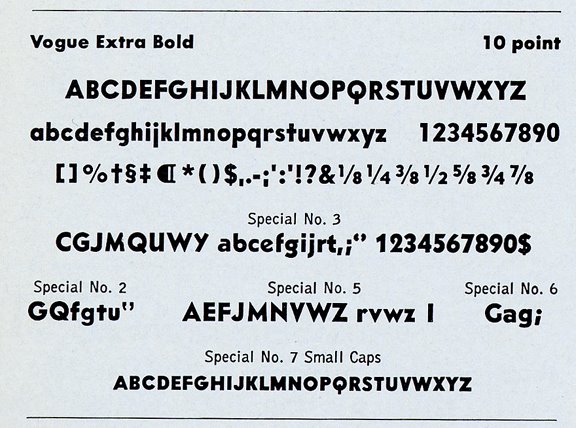
request: digital vogue bold and vogue extra bold


In American Metal Typefaces of the Twentieth Century (Revised Second Edition), Mac McGrew describes Vogue as:

. . .an American sans-serif type, cut by Intertype in light and bold weights early in 1930. It had been created for Conde Nast of Vogue magazine, but was reelased also to the general printing trade. It is generally quote similar to Futura, but caps are the full height of ascenders, and descenders are a bit longer; most noticeable in the original version are the very long crossbar of G and the vertical tail of Q.

It's also one of those fonts that's slipped between the cracks. Find me a foundry with a digital version of the Vogue Bold and Vogue Extra Bold, and I'll. . .I'll. . .be very thankful.

Sunday, September 03, 2006

prototyping: the art of the possible

In a Labor Day picnic this evening conversation turned - as it often does in our neighborhood of self-employed entrepreneur-types - to "the latest and greatest" projects everyone was working on. But in addition to kvetching about "what's already underway", we spent some time talking about an idea one neighbor had for a particular tangible product.

The discussion stalled until we got a very vivid description of what the product looked like - what it felt like, what materials were used, how big it was, how it fit in with the environment it was meant for.

For a software person used to schlepping around early beta product, the shared experience of visualizing a prototype was a real eye-opener, especially the full scope of senses that everyone needed to satisfy their curiousity. The neighbors - none of whom were in the software business - couldn't go any further until they could see the product in their hands, so to speak.

Having done so, the "what ifs" began. There were potential buyers at the table, and potential suppliers; different perspectives on the use case were vetted, new ideas for directions it could go in volunteered.

At the risk of being oblique, the actual product was not meaningful to me - what was fascinating was the process flow of concept to delivery that was encapsulated in that five-minute discussion. Because after five minutes I could see a few prototypes in my mind's eye, and so could everyone else.

My contribution was more along the lines of "if you start with it in this way, here are all the directions you could go in". The art of the possible comes easily to software people who - as everyone knows - live in a world of possibilities. Unburdened by the rigors of physical protyping, our "what if" loop is orders of magnitude faster than the packaged goods guys enjoy.

In other words, it was a great picnic. Happy Labor Day.