Tuesday, May 30, 2006

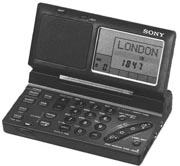
gear: the sony ICF-SW100S shortwave radio

If you do a fair amount of travelling, it is helpful to carry a few essentials with you. My list of "must brings" include sealed packages of kleenex (emergency TP); a personal pharmacopeia that includes melatonin, excedrin, pepto, imodium, a multi-vitamin, benedryl (for random anaphylaxis and insect gnawings) and claritin; a compact Winsor & Newton watercolor kit, Arches #0 brush and paper pad; mints; poisonous tree frog (Wally); playing cards.

But one of the most essential of essentials has eluded me. Over and over I've been stuck in a hotel, or in an airport, or on the road, without access to. . .

The BBC World Service.

Yes, that makes me a world-class geek. But I need my fix of English-language news and sports and other oddness, which means I need access to a radio. Preferably a small radio.

Optimally, the Sony ICF-SW100S shortwave radio.

It's been discontinued by Sony, dambit, but it's still fantastic. The review of this radio on the Universal Radio site gives you some insight into its killer combination of size and power. It can be played closed or open. It can be programmed for 50 stations with a 24 city global clock. It can be thrown at an assailant or held in the hand as a chunky yawara. It tastes awful. It has a dual clock/alarm to make sure you vacate your room prior to the arrival of unwanted visitors, like the Kaiser or Brunhilde the Difficult.

In any event, now that it's been discontinued - the sad fate of so many Sony products these days - I wonder if I'll ever find one.

If you've got a favorite portable shortwave radio you like, let me know. Until I identify an alternative, this is the one I'm pining for.

guide: 10 steps for screwing up a webinar

Webinars, also known as "recorded pitches", are the zesty pairing of a podcast and a slide deck. Typically executed and recorded in Breeze or WebEx or something similar, they are a nice part of your marketing mix. Here are ten easy steps to making sure your next webinar is both a failure and hugely frustrating to yourself and your colleagues:

1. Do them by yourself.

2. Use your best monotone voice.

3. Read each of your slides.

4. Use 12 point Times New Roman. Or 12 point Arial. Or 12 point anything. For that matter, avoid any presentation rules advanced by anyone named Kawasaki. Or Tufte.

5. Don't use pictures.

6. Insist on perfection.

7. Let them run less than 15 minutes or longer than 45 minutes.

8. Leave out a call to action or a reasonable next step.

9. Include content designed for multiple audiences.

10. Rely on them as your sole way of telling your story.

While I think everyone reading ack/nak already knows the surest way to make sure all of your outbound marcom will fail miserably, I include it anyway as a bonus failure tip:

11. Don't bother tracking how many people listen to it.

Saturday, May 27, 2006

review: the da vinci code

Date night doesn't come around often - but when it does, we're fans of dinner and a movie.

Dinner was perfectly nice - the movie was. . .well. . .

Here's what I can say about The Da Vinci Code:

1. It's better than the book.

2. The book was an affront to the English language.

3. The movie's Robert Langdon doesn't carry the title "Master of Exposition".

4. The albino killer monk's skin tone varies from "Navaho White" to "Dover Chalk" to "Slightly Pink" to "Standard Caucasian". Whoever was in charge of this at the Continuity desk should receive a few lessons in powder-puffery.

5. Whole chunks of the book were (mercifully) left out, abbreviated and just plain reinvented for the movie. To good effect, mostly, with the notable exception of. . . .

6. It lacked the sexual tension between Sophie Neveu and Robert Langdon - which means that one of the central tenets of the book (in my opinion) was not just left out, but completely abandoned. No sang real for you, Robert Langdon!

7. The cinematographer deserves an Oscar.

8. I want a library like Sir Leigh Teabing's. I'd settle for the stacks of cool scrolls, incunabula, palimpsets, codexes and librams that were mouldering in that sub-basement at Rosslyn.

9. I forgot how much I miss Paris.

10. I couldn't stop thinking that Sir Teabing would - at any moment - slap on a purple helmet and get all nasty with magnetism after revealing that his true name was Magneto.

All in, not a bad movie experience, but definitely a long one (2.5 hours). Your mileage may vary.

Thursday, May 25, 2006

counterpoint: marketing vs schrodinger's cat


It's one thing to see the problem that everyone else sees. It is entirely another to spot the problem that exists but isn't acknowledged openly. Except the line between known and unknown - solved and unsolved - isn't clear.

The problem I have is that every time I think I've found something novel, I find myself wondering, is it real? Is solving this problem going to make a difference to anyone? Well, enough of a difference worth paying for?

Or does the act of looking for a problem to solve in fact create the problem? Am I inventing problems based on what I know of my ability to solve problems? Does the presence of the hammer in my pocket make everything that sticks up look like a nail?

Kids roll down hills to alter their consciousness - product managers do the same by asking leading questions like, "Seen any good products lately" or "You seem to be scratching your leg quite a lot, do you have scabies?" Because we need to find things that haven't been found yet. That's what we do.

So we go out and look for kooky new problems to solve. And when we think we've found them, those of us possessed of Mad Pursuasive Skillz go back to the shop and convince developers to write code to solve the problem. Which, children, is how software is born.

(How it is shipped is a story for another day)

And here is where it gets difficult.

  • Sometimes you can go with your gut when deciding if the problem is real. Sometimes you need a small fortune's worth of market validation to decide for you.
  • Then you have to figure out if you need to build the whole thing to get paid, or only a part.
  • Then comes the competing interests of different early adopter customers, each of whom wants to turn you into their private development shop dedicated to fixing their unique flavor of the problem you solve first.
  • Then you have to consider whether or not solving this problem keeps you from solving other problems that you really should be solving first.
  • Then you have to decide if your approach to solving this problem is unique, adds value, and gives you a market advantage that's sustainable.

By this time, you've quit your job and started a hotdog stand.

Everyone in software marketing (product management and product marketing alike) likes to think that they've got an eye for novelty - for spotting novel problems and coming up with novel solutions.

The sad fact is that we don't talk to enough people who aren't paid to talk to us. We gather two datapoints and draw a line (to show a trend), then we add a third datapoint to prove we're right, or a fourth if the third doesn't work out quite right.

Cruel, but true. We gather Schrodinger's Requirements, which are based on interactions with two customers whose problems may or may not reflect a market trend, and whose validity cannot be determined. Only the odds of the requirement being valid or invalid can be estimated.

The only answer is to talk to more people. More input = more better. Because hope isn't a valid planning strategy.

Wednesday, May 24, 2006

gear: the brompton folding bike (and general smallness)

For some odd reason, I am fascinated by "smallness".

And what better way to celebrate the "let's get small" mindset than with a bike you can fold up and stow in even the smallest of car trunks.

Brompton bikes are made in the UK and come in three versions, all of which collapse down to a surprisingly small, portable package you can schlepp around with you.

And if you don't groove on the Bromptons, there are other brands of folding bikes, including Dahon, Breezers and Bike Friday bikes.

Imagine pulling one of these babies out of the back of your Mini, or even better, the small trailer towed behind your Isetta.

Like these smiling Czechs.


Or out of your Tab (modern) or Pod (retro) teardrop trailer.

Because the same principle that applies to letters (it's harder to write a short one than a long one) applies to travel. It's harder to kit out a small car than it is to pack all of your possessions into a MegaBehemoth LS.

Anyone else like to "get small"?

Tuesday, May 23, 2006

hook: beginnings lead somewhere

You are at a park walking your doberman when you see a man attempting to pull a little boy into a car. The boy is crying and screaming uncontrollably.

You stop the man from driving away by physically preventing him from getting behind the wheel, all the while calling for help.

A policeman intervenes, as does the father moments later. The child is returned to his father, the alleged kidnapper is taken away, and you go on your way, shaken but feeling strangely elated.

The next day four large men accost you as you're walking your dog near the same park, attempting to maneuver you down a narrow side-street.

Good thing for you the man whose son you saved is also nearby, and this time he intervenes on your behalf. A brief, silent standoff ensues, and soon you find that you and your rescuer are left alone.

Relieved, you strike up a conversation with the man, who pledges his undying appreciation for what you did, promising to "look after you". With a knowing nod, he shakes your hand and walks away.

Your dog can't stop whimpering.

Question: Where does the story go from here?

Question: If the story went nowhere from here, would you remember that it started well, or would you dismiss it?

Question: What is the story of your launch? Who is the protagonist? What is his/her problem? Who is the enemy?

Question: What is the story you want to tell after your product launches?

Question: Do any of your marketing plans tell a story? Or are they dull sequences of action verbs and metrics? Can your buyers see themselves in your narrative? Do they identify with your characters and their issues? Do they consider themselves fans of your style?

Why: Everyone loves a good story. So tell one.

Monday, May 22, 2006

portability: the personal media center

The M3 Adapter GBA Movie Player purports to allow Nintendo DS users to watch movies, listen to music, and G-d help me, play homebrew games. They cost about $90. This is the price of poker for GBA and NDS lovers to get the same multimedia playback abilities of the PSP.

Before you can play, though, you need to buy a memory card. One version of the M3 Adapter supports miniSD cards - dealram shows 2GB miniSD cards running from $65 to $107. By comparison, an equivalent 2GB Memory Stick Pro Duo for the PSP would run from $78 to $167.

All in, tricking a Nintendo DS (or DS Lite) or a PSP as a portable media center will cost about $300. The additional opportunity cost associated with the major pain in the a$$ required to move content onto the device adds untold thousands to the bill.

The lesson here is that people are willing to put up with all manner of bull%$#^ (and expense ) for the privilege of carrying around their favorite media.

This is OK for nerds like me. But what will it take to move this experience into the nerd-free mainstream?

Ideally, I'd like to be able to move content from the DVDs I buy and the content I download directly from either my computer or my DVD player to some sort of mobile device. This device should store the media on a memory device, not on a hard drive.

I am willing to have the license for this content moved to my device with the media - but only in exchange for brain-dead simplicity.

Ideally I'd like to have the option of renting or buying the content I download, and for converting a rental to an owned license.

Ideally, I'd like to combine music and video on the same device.

I don't need to be able to redirect the display of this portable device to a TV.

I want to be able to browse available content by genre, title, director, actor/actress, studio, date of release and "popularity".

Here's what's in it for the publishers of the media - making it easy for clowns like me to get quick, easy and affordable access to the odd crap I like to watch (Kurosawa's Ran, anyone?) means that they can target me for other odd crap that I'm likely to like. Add all of the Bobs up and you have lots of niche markets who will eagerly self-identify for their content of choice.

It's axiomatic that targeted marketing is cheaper than mass-marketing. Doing targeted marketing on the massive scale enabled by this sort of transaction makes it affordable for studios to create content for niche markets - content they've avoided making because it doesn't sell to the unwashed masses.

But with access to niche markets with an appetite for niche content, you turn the equation around.

Will everyone want to carry their favorite music with them? You betcha.

Will everyone want to carry their favorite video with them? If it's accessible, affordable, easy to transfer and available in a steady drip stream, you betcha.

Here's the use case:

"I'll take BBC World, Adult Swim and the Daily Show every day, and the next movie in the Sonny Chiba queue at the beginning of the month. Show me a few other things you think I'd like. Let me queue those up, set the date for swapping Sonny Chiba out for the Yun-Fat Chow series. If I don't get to it, don't charge me for it, but remember that I was interested in it. Also brief me on new items in the following categories, and flag me on the top 10 ranked content items from the following groups."
Sunday, May 21, 2006

burton: voodoo girl


Her skin is white cloth,
and she's all sewn apart
and she has many colored pins
sticking out of her heart.

She has a beautiful set
of hypno-disk eyes,
the ones that she uses
to hypnotize guys.

She has many different zombies
who are deeply in her trance.
She even has a zombie
who was originally from France.

But she knows she has a curse on her,
a curse she cannot win.
For if someone gets
to close to her,


the pins stick farther in.


Voodoo Girl
by Tim Burton
from The Melancholy Death of Oyster Boy & Other Stories
(Rob Weisbach Books, 1997)

And don't forget the merch.

Friday, May 19, 2006

relief: I know what I do now

Thanks for your patience over the last week. It's been busier than normal - so much so that I had to choose between blogging and sleep.

Sleep won, but barely.

And like the ass I am, I took the red-eye again to get home. With predictable results.

But the best news from this week was the Pragmatic Marketing class I took. Mr. Foxworthy was, as promised, excellent, and I'm happy to report that the class has become even more focused over the five years since I last took it.

For those of you who are not familiar with Pragmatic Marketing, visit their home page for an introduction to their mission.

When I say I know what I do now, I mean that in two ways:

I know what I do - the class defines the discrete activities required to market software products. The last time I took the class, the company I worked for had not explicitly embraced their methodology. We have. Having everyone "on the same page" is powerful voodoo. As a result, we all now know what is expected of us at a gross "process morphology" level. Cool.

I know what I do now - setting priorities is always difficult, but it has become even more challenging for me now that I have multiple products that I manage. The class helped me to understand what needs to come first - what the relative sequence of activities needs to be - so that I don't spend all my time doing tactical one-off work as opposed to more strategic tasks that will advise all of the subsequent tactical tasks that I can farm out.

So once we get our gap analysis done, we can start having some real fun.

I'll get back to my regular rhythms of posting now.

Monday, May 15, 2006

slows: travelling to CA, in PPM training

I'm going to be participating in my second Practical Product Management training session over the next three days. This will have an impact on my posting - it certainly got in the way last night, as I caught the late (...very late...) flight to SFO. At least I got to enjoy the Japanese breakfast at the Biltmore , that I wrote about back in January.

It's sunny here - a big step up from Chicago, which has been trapped in mid-40s rain for the last week.

If any of you have questions about the course, let me know.

Saturday, May 13, 2006

patent: call detail record (cdr) analysis

Recent news regarding government acquisition and analysis of civilian phone call data has been woefully lacking in detail about what was captured. I've identified a US Patent (USP 6385301) that you can read that will give you some insight into what could be divined from the sort of raw data that flows off of a switch - if you go the extra mile to put it into a useful analytical state.

The holders of this patent, Tom Nolting and Rich LaPearl, were looking for a novel way to analyze call traffic in order to improve the efficiency of their network. I sold them the software they used to do this work (the software package is cited in the patent) while they were at Bell Atlantic in the late 90s, and in the process learned a lot about just how much you can do with this information.

It's important to note that at no time did any of the information captured, stored or analyzed in this process have anything to do with the content of the call(s).

At the raw level, CDR data gives you access to the following:

a) Whether the call is terminating or originating

b) The total carrier elapsed time (time between when the call was initiated and when it was released)

c) The total customer elapsed time (time between when the call was answered and when it was released)

d) Whether the call was answered and how it was cleared (i.e., busy, normal clearing, etc.)

e) The date and time the call began

f) The originating and terminating number (NPA-NXX-XXXX)

Where NPA is the 3-digit Numbering Plan Area (Area Code) and NXX identifies the central office exchange allocated within the NPAs and XXXX are the consecutive last 4 digits of a NANP 7-digit local phone number (N is any digit from 2-9, and X from 0-9). This format is standard across North America per the North American Numbering Plan, and is managed by the creatively-named North American Numbering Plan Administration.

While Nolting and LaPearl specified a multi-dimensional database in their patent, I've seen other sorts of data management systems used with success for this sort of work. Specifically the Sybase Adaptive Server IQ database, which employs bitmapped indicies for high- and low-cardinality datatypes to speed analysis. The issue with this sort of work isn't necessarily the data storage problem - it's the data analysis problem, especially if you want to correlate the CDRs with external data. That's where the multidimensional database came in handy.

Wednesday, May 10, 2006

epiphany: nintendo and the WOPR rule

In the aftermath of E3, I've discovered that I don't want more pixels, I don't want Blu-Ray, and I don't even want XBox Live or HD resolution.

I just want to get my hands on the Wii Nunchaku and swing it around for a while with my kids.

Instead of allowing Sony and Microsoft to define what it meant to compete in the "next generation platform war", Nintendo sought a different path. In a move worthy of an aikido master, they seemed to have turned the strengths of their competitors against themselves.

From everything I can tell after watching the E3 presentations, Nintendo's graphics certainly weren't the fanciest of the three claimants to the throne - but everyone on stage and in the audience at the Nintendo presentation seemed to be having more fun than the others. Watching a guy run around a stage playing tennis by waving his remote at a screen was a hoot. Fifteen seconds of that sold me, moreso than an hour of droning stats on mips and pixel counts.

Who cares if their systems are more powerful, I can hear them say. That's not the goal of a video game. The goal is to have fun, and we will make it possible for more people to have more fun with our machine than the other guys, in more innovative ways, at a better price-point.

It's obvious to me that Nintendo learned the WOPR rule - "The only way to win is not to play."

As the Fish is known to say, you can't engineer fun. But you can lay the foundations for it, and Nintendo seems to have done just that. They've changed the rules to serve their strengths.

It's going to be a most excellent holiday season.

Tuesday, May 09, 2006

doggerel: it takes a team to write a pitch


When you think that you know
All the content to show
On every last slide of your pitch

With great erudition
And cool slide transitions
prepared and compared 'till you twitch

But you're never finished
Until you have sent it
To someone who thinks differently

Who tears up your premise
And says "I don't get it"

Who reshapes your thesis
In new odd-shaped pieces

Then puts it together
a little bit better

So everyone sees what you see

It Takes a Team to Write a Pitch
from Doggerel for Carp
(Shite House, 2006)

Monday, May 08, 2006

challenge: writing a value proposition (UPDATED)

(Wow, this is sure a popular article. Was it useful to you? Let me know.)

It's one of the fundamentals we often gloss over in lieu of other more exciting fare. But how many of us actually take the time to write down - much less research and justify - the value propositions associated with the products we make, market and sell?

I think people avoid it because doing it well is hard, and doing it artfully well is even harder.

What is a value proposition? A value proposition is a simple statement that describes what real value a customer can expect to get from your offering.

Value - like beauty - is in the eye of the beholder. If someone hearing your value proposition shrugs and says "so what", either you've failed to align the value you deliver with what they care about, or you've articulated features and benefits instead of value.

If you've never written a value proposition before, start with this primer. The result may be a bit awkward-sounding, but it will be substantively correct:

First Sentence (describes value)
  • For (target customer)
  • who (statement of the need or opportunity),
  • the (product/service name) is a (product/service category)
  • that (statement of benefit).
Second Sentence (positions value)
  • Unlike (primary competitive alternative),
  • our product (statement of primary differentiation).

When you're done, take your hands off the keyboard and sit back. Take a long look at what you've written. If you've filled in the blanks honestly, you've got an honest-to-goodness value proposition that speaks to something important (and perhaps unique) that you can do to solve someone's problems better than that other guy can.

Congratulations!

Sadly, many value propositions I read are not written correctly, even if they are written beautifully. Here are a few of the mistakes well-meaning people make that severely diminish the impact of a written value proposition:

  1. Talk about features - the value proposition has nothing to do with individual features of your product. Features solve customer problems - solving the problem is your value. Transitive, yes, but you need to go up a few levels of abstraction for your value proposition. Besides, features change and evolve, but the value should remain constant (or grow).
  2. Use big words - a good value proposition is all about the pithy. Rather than use two words, use one. I spent a good ten minutes today worrying about the subtle differences between the words "efficient" and "nimble" (efficient won).
  3. Use jargon - certain words and phrases mean nothing, no matter how often you say them or how much you believe in them. "Industry-leading" and "revolutionary" and "user-friendly" are just a few. Be especially careful about invented words, and smart-sounding replacement words (like "leverage" for "use") and acronyms. If you use the phrase "paradigm shift", beware the hammer of G-d come to smite you into pudding.
  4. Employ hope - value propositions should reflect values that people can actually realize from the use of your goods/services today. This is especially difficult for technologists, who know of every blemish in the product, and who honestly believe that it won't be truly useful for. . . another year, maybe two. If the customer can get value from the product today, that's one thing. If it's coming in the "next release", that's semi-OK. If you need your roadmap to become reality to make it true, don't write it into your value proposition.
  5. Write it blind - there is nothing wrong with chutzpah. But you can't use words like "first" and "only" and "best" and "most" unless they're true. Better to avoid superlatives entirely. But if you're absolutely married to one of them, do your research and figure out if anyone has gotten there first, or better, or generally superior to you. Then make sure that whatever measures you use are demonstrably correct - since marketing wins when it's objective more often than when it's subjective.

In the final assessment, I think writing these things, like most creative endeavors, is a gift - the true artistes do it without truly understanding how they do it, but we all know a good one when we read it. That's the test - is it a blunt instrument of truth or a vaguely distateful exercise in lying?

Epilogue - it's been almost two years since I first wrote this, and I'll be frank when I say that writing a value proposition never gets easy. It challenges you to write down what is real about your product, the problem you're trying to address, and your assessment of how you stack up against your competitors. I guess that's what makes it important - the easy things are rarely valuable. So get writing.

Sunday, May 07, 2006

sirowitz: how to pray


Don't pray for material things,
Mother said, like a new football helmet.
God doesn't like that. Save Him
for bigger things, like if one of us
gets very sick. The way to get
on His good side is to ask for
general things, like health & happiness.
And tell Him he doesn't have to give them
to you now, you'll take them in the future.


How to Pray
by Hal Sirowitz
from Mother Said (Poems)
(Crown Publishers, 1996)

Friday, May 05, 2006

pause: some days you just say no

It's been a heck of a week, notable for the fact that I said "no" more often than I said "yes".

No, I can't do that storyboard.

No, I can't write that channel brief.

No, I can't do that meeting, or that meeting, or that meeting.

When the sirens had stopped, I realized that saying "no" was the smartest thing I've done in a very, very long time.

Because my saying "no" brought out the best in colleagues who realized I was "full", and who stepped up to help manage stuff that frankly had been paralyzing me with abject fear and loathing.

Sometimes the job just looks too damn big for words. Saying no helps.

Thursday, May 04, 2006

design: making software <> making whistles

Why do most software producers follow principles of manufacturing that are effectively identical to makers of, say, whistles? Exampli gratia: Acme Whistles.

These guys have been making whistles - yes, whistles - since the mid-19th century. Originally a side-business for a former farm worker turned tinkerer, Acme Whistles are made to serve a surprisingly large variety of distinct whistling needs.

Yes, differerent sorts of people have very different requirements when it comes to a whistle - soccer refs have different whistle needs than policemen than dog trainers than duck hunters, right? Why should they be obliged to use the same whistle?

Their ability to deliver the right product to the right user at the right price - following a unique design and marketing sensibility - distinguishes them in an otherwise invisible marketplace.

Applied to the software world, why can't we make products tailored to the specific needs of different users? And not just once - all the time, over and over, and lightning-fast? We're not bound by the same manufacturing limitations as a whistle manufacturer, are we? We don't have to build completely different products to meet the needs of different buyers?

But wait. That's how most software is built.

When your packaging (and by association, pricing) is embodied in the physical design of your software - when you have to create a separate binary for each unique feature combination you want to ship under a unique "edition" name, you're making whistles.

When you have to stop the manufacturing process every time marketing walks into the shop with a new wacky way for users to use your product - whether it's "we need a demonstration version" or "a version with only these features that times out in a week unless you buy it, in which case it has these features, unless you upgrade it in which case it has all features". . .

. . .you're making whistles.

(More often than not, development tells marketing to "wait for the next release". By which time the customer - and in many cases the opportunity - have gone away)

When you've got nine different licensing schemes and your head of sales wants to offer a "solution" that combines all nine of them under a single license, and you decide the only way to do it fast enough is to define a manual "workflow" for generating new licenses for the constituent products and matching them with the new "master" license and another manual "workflow" to register sales (and upgrades and license transfers) with the different ERP and CRM systems that those point products are integrated with. . .

. . .yup, you're making whistles. Complicated whistles at that.

The solution isn't to do away with packaged software and go all SaaSy. Software producers need to embrace the fundamental right granted them by their Creator to reject a manufacturing process that Henry Ford would recognize, and that Deming would applaud.

If you can decouple the product definition and development steps from the product pricing and packaging steps, you're on the right path.

If you can get your development team to make everything they build "change ready" from the very beginning, you can break the linear process mindset that keeps so many software producers mired in the 19th century.

Because unlike whistles, the software package is a fluid thing that should draw from a common well of functions. The package is whatever combination of features that make sense for a given customer - priced based on the usage model that they'll embrace.

Wednesday, May 03, 2006

oops: msn gets the moussaoui verdict wrong

In a blunder of near-Dewey Beats Truman proportions, the journalistas at MSN got one of the biggest stories of the day - the Moussaoui verdict - dead wrong on their home page today.

When the story first broke, here's what you saw on the cover page at MSN:


Hmm. Not. . .quite. Later on, the folks running page one actually read the story, and voila, replaced this graphic with the following:


Now I'm normally a forgiving guy. But I was living in the NY area on 9/11, and I still carry the NYT obituary for a friend who died that day. If I'm angry about this blunder, I can only imagine how those whose lost a family member feel about MSN's sloppiness, no matter what they feel about the ultimate verdict.

Do better.

Tuesday, May 02, 2006

MSFT: the giant is officially awake

The now-public "Don't Panic" letter (allegedly) penned by Microsoft CEO Steve Ballmer is a sad testament to both the short-sightedness of Wall Street and the asymmetrical battle underway between Microsoft and Google. But most of all, it's the clearest sign yet that the Microsoft "sleeping giant" is now officially awake.

First reported on by Bloomberg News this morning, the full text of the letter made its way into the hands of Todd Bishop (beware of pop-ups at the link to the left) later on. Here it is in all its (alleged) glory:

Throughout our history, Microsoft has won by making big, bold bets. We've always taken a long-term approach, striving to solve the hardest problems in computing and working to realize huge new opportunities in vast new markets through investments in innovation across the broad spectrum of human endeavor.

I believe that now is not the time to scale back the scope of our ambition or the scale of our investment. While our opportunities are greater than ever, we also face new competitors, faster-moving markets and new customer demands.

So what accounts for the negative reaction that we've seen from analysts and investors?

To ensure that we win where we see opportunities and can respond with speed when the marketplace changes, we made the decision to ramp up investments during Q3 in a number of key areas. In addition, the cost of producing Xbox 360 consoles was higher than expected, while at the same time we decided to manufacture and sell as many consoles as possible to build on our lead in the race to be number one in the video game business.

These investments will continue. As a result, we also provided guidance for Q4 of this fiscal year and for FY07 that indicates our willingness to be aggressive when making investments where they are strategic for future growth.

The bottom-line result of these investments created a shift in our near-term profitability that was a surprise. The change in our stock price reflects this.

But I've never been more confident that we are making the right investments. In addition to adding a third manufacturing facility to enable us to meet market demand for Xbox 360, we are investing heavily in our services strategy; in our readiness programs for the launch of Windows Vista, Office 2007 and other products in the pipeline; and in a number of other areas where we see opportunities for rapid growth. We've accelerated the pace of our hiring and increased spending to ensure that we continue to bring the world's brightest minds to Microsoft.

When you look across the array of businesses we are building, it is clear that we are in a position that no other company can match. We have made and we continue to make the investments needed to ensure strong growth for our core businesses, while delivering the innovation that is essential to establishing a leadership position where we see opportunities in businesses such as entertainment, mobile devices, search and software-based Internet services.

I say "alleged" because I find it hard to believe that it would be necessary to explain to all of the smart people at Microsoft (and beyond) that investments mean "increased costs" which in the short-term translate into "less profit". Also because I didn't get a copy sent to me by Mr. Ballmer. One must be honest about the provenance of such things, after all.

The fact that Wall Street would punish Microsoft for making hard business decisions in the face of a competitor like Google is appalling to me. Especially when that competitor's entire business plan seems to be guided by a Brownian Motion producer.
Come on kids, let's be honest with each other - when the majority of recently "launched" products (if betas count as launches) come from unplanned, unstructured and unmanaged "20% time", it's pretty clear to me that Google is making this stuff up as it goes along. And it's being rewarded by the Street. Go figure. When the money machine runs out, they'll be left with lots of smart people writing widgets.

That Microsoft should be making investments to advance its franchises is no surprise. That the stock should take a hit based on the Street's fascination with "show me the money now" business practices is - unfortunately - no surprise either. But I'm surprised that the speculators who dumped MSFT didn't dump GOOG at the same time - since its clear that Google has woken the sleeping giant enough to make it want to piss off the Street.

Some random final thoughts:

  • If Mr. Ballmer was willing to take that sort of hit at the same time that he's under the gun for (alleged) continued Vista slippages, then dang, it's time for non-combatants to step back slowly and take cover.
  • And when/if Google starts to complain about so-called "anti-competitive practices" by Microsoft, they won't find Justice as sympathetic as they were towards Netscape. Oops, they're already complaining. Gosh.
  • I'm not quite ready to draw the Scut Farkus and Ralphie comparisons yet, but give me time. I also erased the "kudzu complaining about getting splashed with Roundup" analogy, which I think was especially mature and non-hyperbolic of me.

Monday, May 01, 2006

branding: mysterious ubiquity

The standard definitions of brand equity break down when the brand in question is a movement - a shared feeling - that is only peripherally associated with a product.

(photo by akav via flickr)